
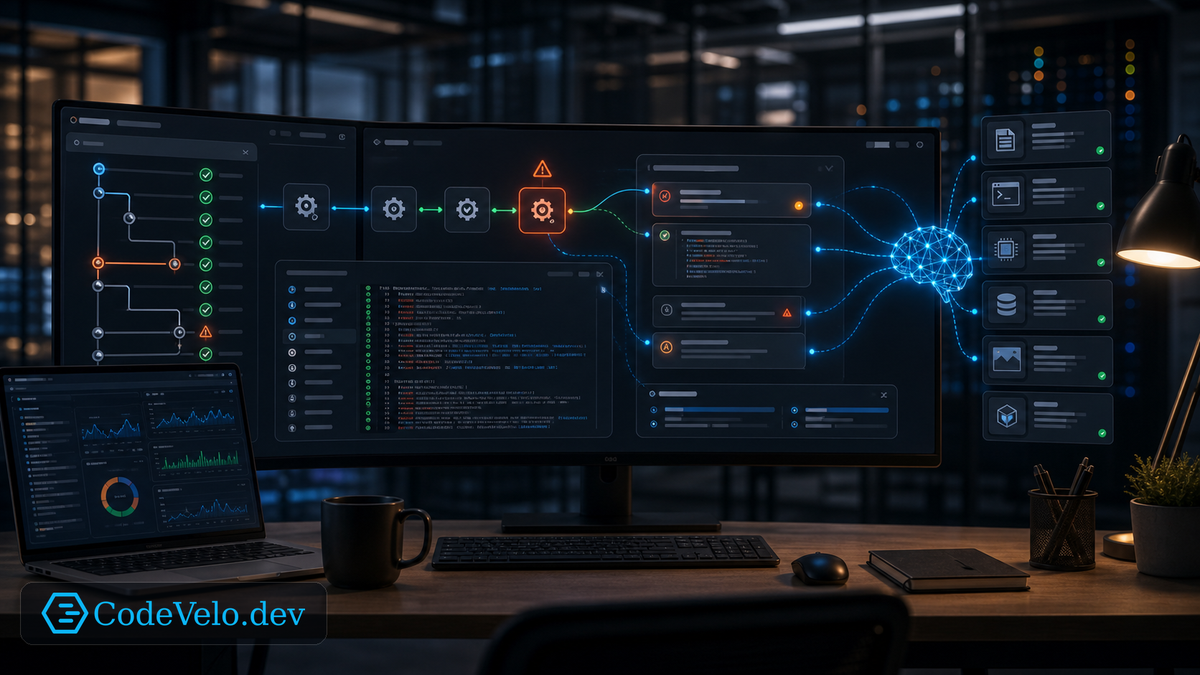
Continuous integration already automates the obvious parts of the build. It runs tests, checks formatting, scans dependencies, and blocks broken changes.
The next step is triage.
Agentic CI can read failing logs, group related failures, compare against recent commits, suggest likely owners, and open a small fix. Used well, it saves engineers from repeatedly reconstructing the same failure context.
Used carelessly, it becomes a noisy system that creates patches nobody trusts.
Start With Explanation
The first useful job for a CI agent is not writing code. It is explaining failure.
A good triage summary should answer:
- Which job failed?
- What changed recently?
- Is this failure new or flaky?
- Which files are implicated?
- Which owner or team should look first?
- What evidence supports the conclusion?
This reduces cognitive load without changing the codebase.
Patch Small, Review Normally
When agents do create fixes, the scope should be narrow.
Good early candidates include typo corrections, snapshot updates, formatting drift, dependency lockfile alignment, and mechanical test expectation updates. Riskier changes should remain recommendations until a human reviews the reasoning.
The review bar should not drop because the author is a bot.
Protect The Pipeline
CI agents need boundaries:
- No secrets in prompts or logs.
- No write access outside intended branches.
- No silent merges to protected branches.
- Clear attribution for generated commits.
- Audit logs for prompts, tool calls, and decisions.
Automation should make the pipeline easier to inspect, not harder.
Measure Trust
The success metric is not the number of bot commits. It is reduced time-to-understanding and fewer repeated failures.
Track how often agent summaries are useful, how often suggested fixes are accepted, and how often they create review churn. If developers ignore the bot, the workflow has not earned trust.
Agentic CI should behave like a careful junior operator: fast at gathering context, cautious with authority, and explicit about uncertainty.