
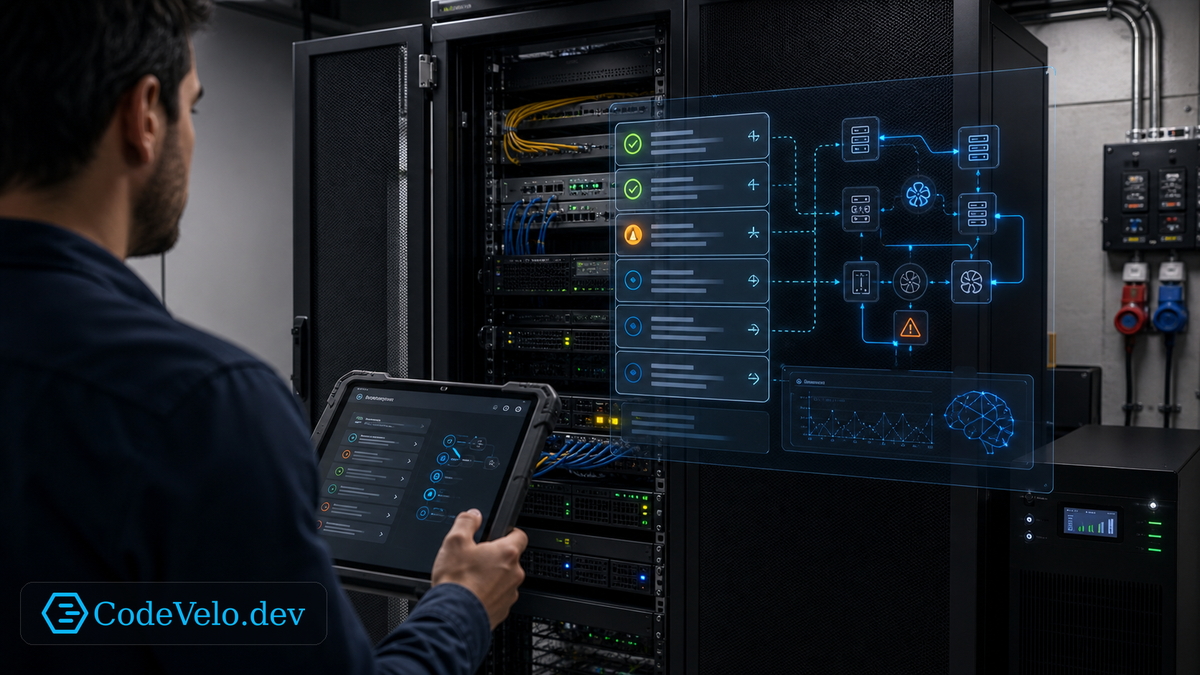
Automation usually starts in the cloud, but many outages still begin in a closet, rack, panel, conduit, or patch field.
That is why AI runbooks need to understand physical infrastructure. A useful assistant should know which UPS feeds the PoE switch, which firewall owns the WAN handoff, which access points depend on a closet switch, and which circuits should never be cycled during business hours.
Without that context, an AI runbook is just a faster way to guess.
The Runbook Needs A Map
Most operational documentation is written for humans who already know the room. AI needs more explicit structure.
Capture the topology:
- Rack, device, and port relationships.
- Power path and UPS dependencies.
- ISP handoff and firewall ownership.
- VLAN and switchport purpose.
- Maintenance contacts and escalation boundaries.
The goal is not a perfect digital twin on day one. The goal is enough structured context that the assistant can propose safe next steps instead of generic advice.
Separate Advice From Authority
An AI runbook should not have unlimited permission to act.
Some actions are safe to suggest. Some are safe to execute after approval. Some should remain human-only. Restarting a non-critical service is different from power cycling a core switch. Changing a switchport description is different from modifying routing.
Define authority levels before the incident:
- Read-only diagnosis.
- Suggested remediation.
- Approved low-risk automation.
- Human-only critical actions.
Trust improves when the system knows its limits.
Make Evidence Part Of The Answer
AI operations become dangerous when they sound confident without showing why.
A useful runbook response should cite the signals behind the recommendation: device status, logs, monitoring history, topology records, and recent changes. If the evidence is incomplete, the assistant should say so.
That turns the tool into a decision aid instead of an oracle.
Keep The Human Path Clear
The server closet is still a physical place. Someone may need to look at LEDs, trace a cable, replace a module, or verify power.
AI runbooks should produce short, ordered, physically executable steps. They should name the rack, device, port, and expected result. They should also stop when the next action could increase blast radius.
Good automation is not about removing humans from operations. It is about removing avoidable confusion when time matters.