
For decades, the copper Ethernet cable has been the undisputed king of the office. It’s cheap, durable, and gets the job done. But as we move into 2026, the data demands of high-performance teams—especially those working with local AI model training, 8K video production, or massive dataset manipulation—are pushing copper to its physical limits.
At CodeVelo.dev, we’re increasingly seeing a shift. The question isn't just about speed; it's about the ceiling. When does your Structured Cabling need to transition from copper to glass?
1. The 10Gbps Copper Wall
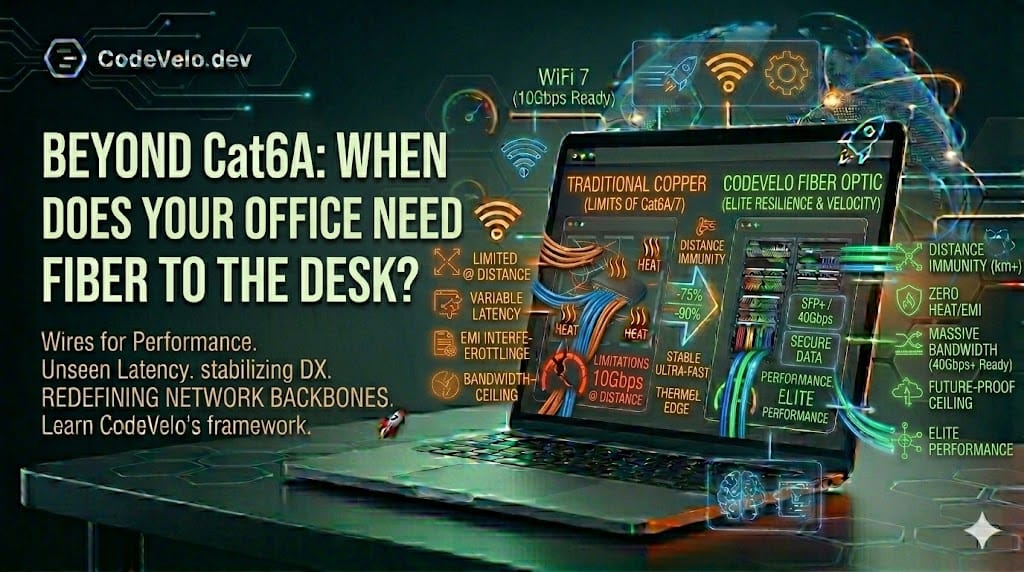
While Cat6A is rated for 10Gbps, it struggles with heat and interference at its maximum distance (100 meters). As you push closer to that limit, the power required to maintain that signal increases, leading to higher temperatures in your Network Rack.
Fiber-to-the-Desk (FTTD) eliminates these concerns. Fiber optic cables don't generate heat, are immune to electromagnetic interference (EMI), and can maintain 10Gbps, 40Gbps, or even 100Gbps over kilometers without breaking a sweat.
2. Future-Proofing for AI and Heavy Media
If your team is constantly pulling large assets from a local NAS or training internal AI models, the "bottleneck" is often the physical port. Modern workstations are now shipping with SFP+ ports or high-speed Thunderbolt adapters that can bypass traditional RJ45 limits.
By running fiber directly to high-intensity workstations, you move the performance bottleneck away from the physical layer. This allows your developers and creatives to work at the speed of their storage, not the speed of their wiring.
3. Security and Longevity
Fiber is inherently more secure than copper. It doesn’t radiate signals that can be intercepted, and it’s nearly impossible to "tap" without breaking the connection. Furthermore, once you pull fiber, you are set for the next decade. While copper standards change every few years (Cat6, Cat6A, Cat8), the glass stays the same—you simply upgrade the transceivers on either end to go faster.
The CodeVelo Verdict
Copper is still great for PoE devices like cameras and APs, but for the "Power Users" in your office, fiber is the elite choice for 2026. It’s an infrastructure investment that turns your office into a true high-velocity environment.
Is your office hitting a bandwidth ceiling? CodeVelo designs and installs hybrid copper/fiber networks that scale with your ambitions. Let’s talk about your backbone at CodeVelo.dev.