
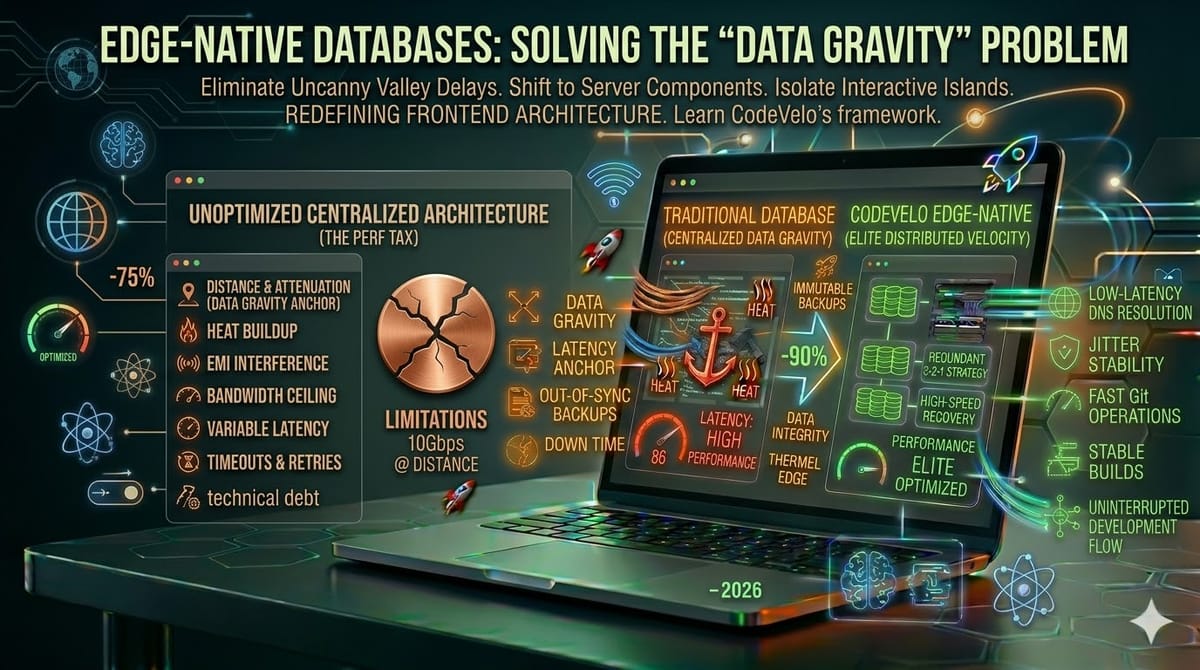
We have spent years optimizing the "frontend" of the web, moving our UI to the Edge and adopting Zero-JS Renders. But for most applications, there is still a massive anchor dragging behind: the centralized database.
This is the problem of Data Gravity. No matter how fast your frontend is, if your user is in London and your database is sitting in a single data center in Virginia, every request is doomed to a 100ms+ round-trip delay. At CodeVelo.dev, we believe the final frontier of performance in 2026 is the Edge-Native Database.
1. The Latency Gap
In a traditional architecture, your compute (the code) might be at the edge, but it still has to "call home" to the mothership to fetch data. This creates a bottleneck that no amount of code optimization can fix.
Edge-native databases (like Turso, Macrometa, or Cloudflare D1) solve this by placing read-replicas—or even full primary instances—globally. When a user interacts with your app, the data is fetched from a data center just a few miles away, rather than across an ocean.
2. Global State, Local Speed
The challenge with distributed data has always been consistency. How do you ensure a user in Tokyo sees the same inventory as a user in New York?
Modern edge-native solutions use advanced consensus algorithms and "physical-layer" optimizations to sync data across the globe in milliseconds. This allows for:
- Instant Personalized Content: No more "loading spinners" while waiting for user preferences.
- Real-Time Inventory: Critical for e-commerce sites where overselling is a death sentence.
- Seamless Authentication: Edge-side session validation that feels instantaneous.
3. From Copper to Cloud: The Unified Pipeline
Just as we advocate for Fiber-to-the-Desk to remove physical bottlenecks, edge-native databases remove the architectural bottlenecks of the cloud.
At CodeVelo, we treat your data architecture with the same precision as a Clean Rack Build. If your physical network is fast, but your database is slow, your "Velo" (velocity) is zero. We bridge that gap by aligning your local infrastructure with global data distribution.
The CodeVelo Verdict
In 2026, "centralized" is synonymous with "slow." To build a truly elite application, your data must live where your users live. Edge-native databases are no longer a luxury; they are a requirement for any product that treats Performance as a Feature.
Is your database anchoring your performance? CodeVelo helps teams migrate to distributed data architectures that scale globally without the lag. Let’s eliminate your data gravity at CodeVelo.dev.