
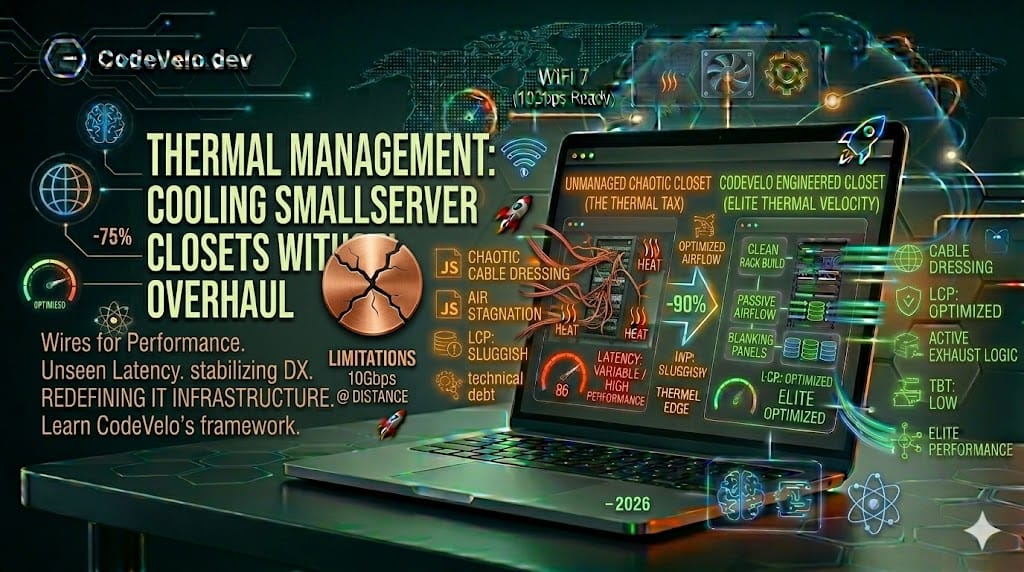
You can upgrade your network stack, pull Fiber to the Desk, and size the perfect Pure Sine Wave UPS, but if your server closet looks like a chaotic wiring experiment, you are inviting thermal disaster. Heat is the ultimate physical bottleneck, and for most small businesses, the classic utility closet is the network bottleneck.
At CodeVelo.dev, we specialize in velocity, and that means managing the physics that destroy it. While we engineer high-performance Islands Architecture web apps, we also engineer the physical environments that host your build pipelines. Here is how to stabilize the temperature in a small network closet without installing a costly dedicated HVAC system.
1. The Chaos Tax: Cleaning Up the Airflow
The single biggest obstacle to effective cooling isn't the lack of AC; it's air stagnation caused by poor management. Before you spend a dollar on equipment, you must eliminate the physical interference.
- Clean Rack Builds: Untamed, bundled cables behind switches act like insulated blankets, trapping heat. We use structured patch panels and precise cable dressing to maximize airflow through the gear, not around it.
- Passive Management: Blanking panels (simple plastic inserts) are non-negotiable. If you have an empty 2U slot between active servers, cold air will take the path of least resistance, bypassing the hot components. Blanking panels force that air through the machines.
2. Engineered Active Airflow: The Closet Fan
If passive management isn’t enough, you must introduce dedicated airflow optimization. For small closets sharing a wall with an air-conditioned office space, the answer is often a Closet Door or Ceiling Fan System.
We use specialized, logic-driven fan panels (like those from AC Infinity) that are installed directly into the closet door or the drywall ceiling. These systems monitor the closet-to-office delta (the temperature difference) and active-exhaust the hot air into the larger, climate-controlled space.
It uses significantly less power than an AC unit and capitalizes on the existing cooling capacity of your office. This aligns perfectly with CodeVelo's focus on Efficient Infrastructure Deployment—why buy more power when you can optimize what you have?
3. The Power Connection: Cooling and Resiliency
Your cooling strategy is only as good as your power supply. If your new closet exhaust fan shuts down during a power dip, your hardware will rapidly overheat.
This is why we treat power and cooling as a unified pipeline. We size Online Double-Conversion UPS units to provide "Pure Sine Wave" power to critical infrastructure, and we ensure that active cooling fans are prioritized on that clean power loop. We align your PoE++ power budget with your thermal capacity.
The CodeVelo Verdict
Thermal management is an elite infrastructure requirement, not an afterthought. In 2026, velocity demands environmental stability. Clean your rack, manage your blanking panels, and integrate smart exhaust logic. Your network performance is directly proportional to how efficiently you move heat.
Is your server closet a silent hardware killer? CodeVelo provides full environmental audits, structured cabling refactors, and smart cooling deployments. Stabilize your infrastructure temperature at CodeVelo.dev.