
In the world of high-performance web development, we spend a lot of time talking about "Uptime." We build Edge-Native Database redundancies and 3-2-1-1 Backup strategies to ensure data is always available. But there is a physical reality that can bring all that digital velocity to a screeching halt: the power outlet.
At CodeVelo.dev, we’ve seen elite WiFi 7 deployments fail because of a 50-millisecond power flicker. As office hardware becomes more powerful, the way we protect that power must evolve. It’s time to talk about sizing Uninterruptible Power Supplies (UPS) for the modern, high-draw PoE switch.
1. The PoE++ Power Surge
Modern infrastructure is "Power over Ethernet" (PoE) heavy. We aren't just powering a few desk phones anymore; we are powering WiFi 7 Access Points, 4K security cameras, and even smart LED lighting.
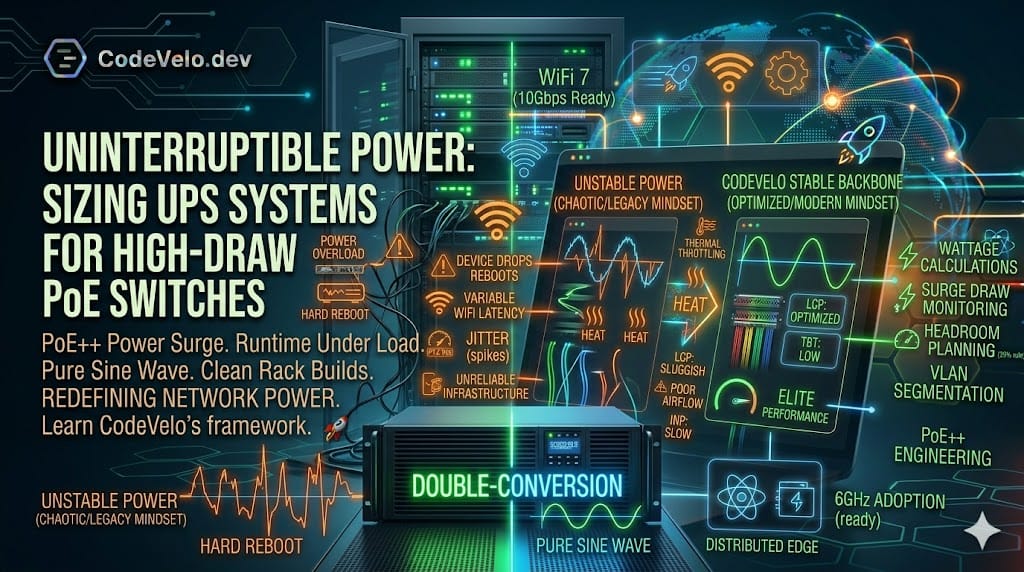
Standard PoE (802.3af) provided 15W per port. Modern PoE++ (802.3bt) can draw up to 90W per port. If you have a 24-port switch fully loaded with high-performance gear, your switch isn't just a networking device—it’s a high-wattage appliance. If your UPS was sized for 2018's power demands, it will likely overload and shut down the moment a power dip occurs, causing a hard reboot of your entire VLAN-segmented network.
2. Calculating Your "Runtime Under Load"
A UPS isn't just a battery; it’s a bridge. Its job is to keep the physical-to-digital bottleneck open long enough for your backup generators to kick in or for your servers to perform a graceful shutdown.
When sizing a UPS, you must calculate your Total Potential Draw:
- Idle Load: What the switch uses just to stay on.
- PoE Budget: The sum of all connected devices at their peak draw (e.g., a PTZ camera moving or an AP handling 100 concurrent users).
- The 20% Headroom Rule: Never load a UPS past 80% of its rated capacity.
A UPS that says "1500VA" might only give you 5 minutes of runtime if you are pushing 900W of PoE++ traffic. For high-velocity teams, 5 minutes isn't enough—you need enough buffer to ensure your Build Pipeline doesn't corrupt during a write cycle.
3. Pure Sine Wave: Protecting Sensitive Silicon
Not all power is created equal. Cheap UPS systems produce a "Simulated Sine Wave," which is essentially "choppy" power. While fine for a lamp, it can be lethal for high-end networking gear and servers.
We advocate for Double-Conversion (Online) UPS systems. These units constantly convert power from AC to DC and back to AC, providing a "Pure Sine Wave" that is perfectly clean. This eliminates the small electrical "noise" that can cause mysterious packet loss or hardware degradation in your Clean Rack Builds.
The CodeVelo Verdict
Digital resilience starts with electrical stability. If your power strategy is "just plug it in," your Performance as a Feature strategy is built on sand. Protect your high-draw switches, and you protect your uptime.
Is your network rack one power flicker away from a total shutdown? CodeVelo provides full power-load audits and UPS deployments to keep your infrastructure humming. Secure your power at CodeVelo.dev.