
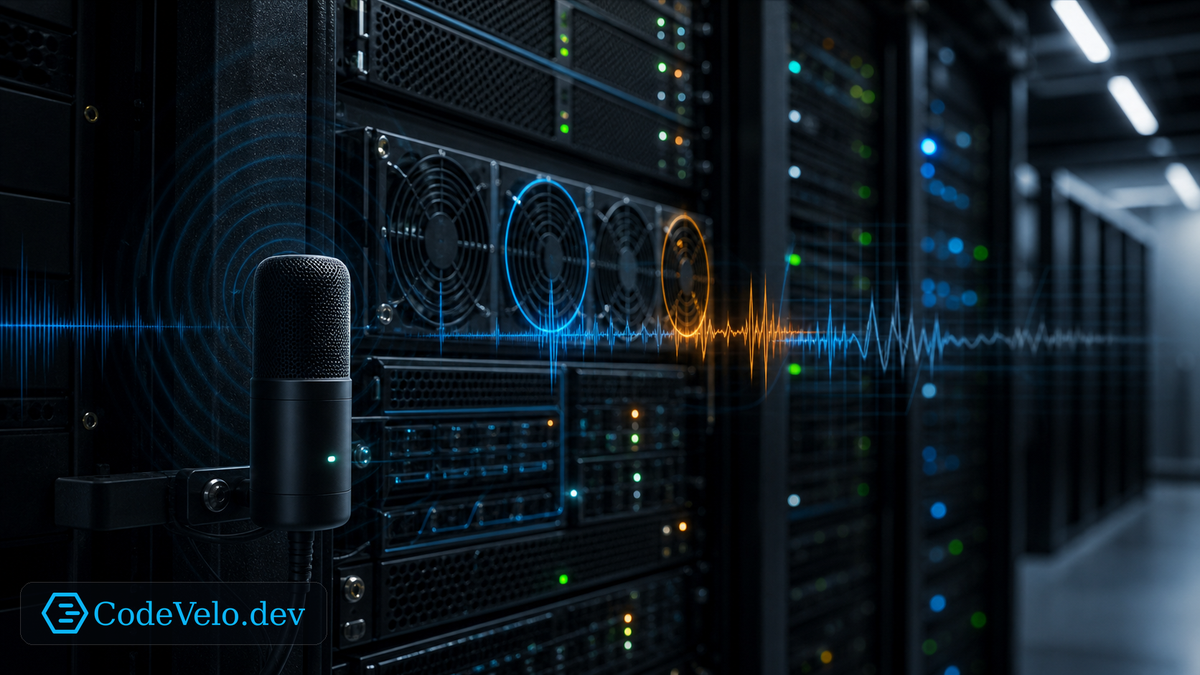
Hardware usually tells a story before it fails. A bearing starts to whine. A fan develops a pattern. A power supply hum changes pitch. Airflow shifts. The rack sounds different before the dashboard turns red.
Acoustic monitoring turns that sound into data.
For mission-critical rooms, small microphones and edge models can detect changes that traditional monitoring misses. Temperature, voltage, and SMART data are useful, but they do not always catch the physical symptoms early enough.
Sound Is A Physical Signal
Every rack has a baseline. Fans spin at expected ranges. Drives and power supplies create familiar harmonics. Cooling systems cycle in repeatable patterns.
When the sound changes, something changed in the physical environment.
That does not mean every noise is an incident. It means audio can become another input in the monitoring stack. The value comes from comparing current sound against a known baseline and correlating it with telemetry.
What To Listen For
Practical acoustic monitoring focuses on patterns:
- Fan whine that rises without a matching thermal cause.
- Bearing noise that becomes rhythmic or uneven.
- Power supply hum that changes under stable load.
- Rattle from loose panels, trays, or cable strain.
- Sudden silence from equipment that should be moving air.
The goal is not to record conversations or create a surveillance system. The goal is to listen to the equipment.
Edge Processing Matters
Audio data can be sensitive and large. A better design processes it near the rack and sends only derived signals upstream.
That might include anomaly scores, frequency bands, device zones, confidence levels, and event timestamps. Raw audio can stay local or be sampled only during controlled diagnostics.
This approach protects privacy, reduces bandwidth, and makes the system more useful during network issues.
From Alerting To Maintenance
The strongest use case is predictive maintenance. If acoustic patterns show a fan degrading over days, the team can replace it during a planned window instead of during an outage.
Pair sound with temperature, airflow, power draw, and device health. A single unusual tone may be noise. A tone plus rising temperature plus fan RPM instability is a work order.
Acoustic monitoring is not a replacement for SNMP, logs, or physical inspection. It is a missing sense in the operations stack.
The rack is already speaking. The question is whether the monitoring system can hear it.