
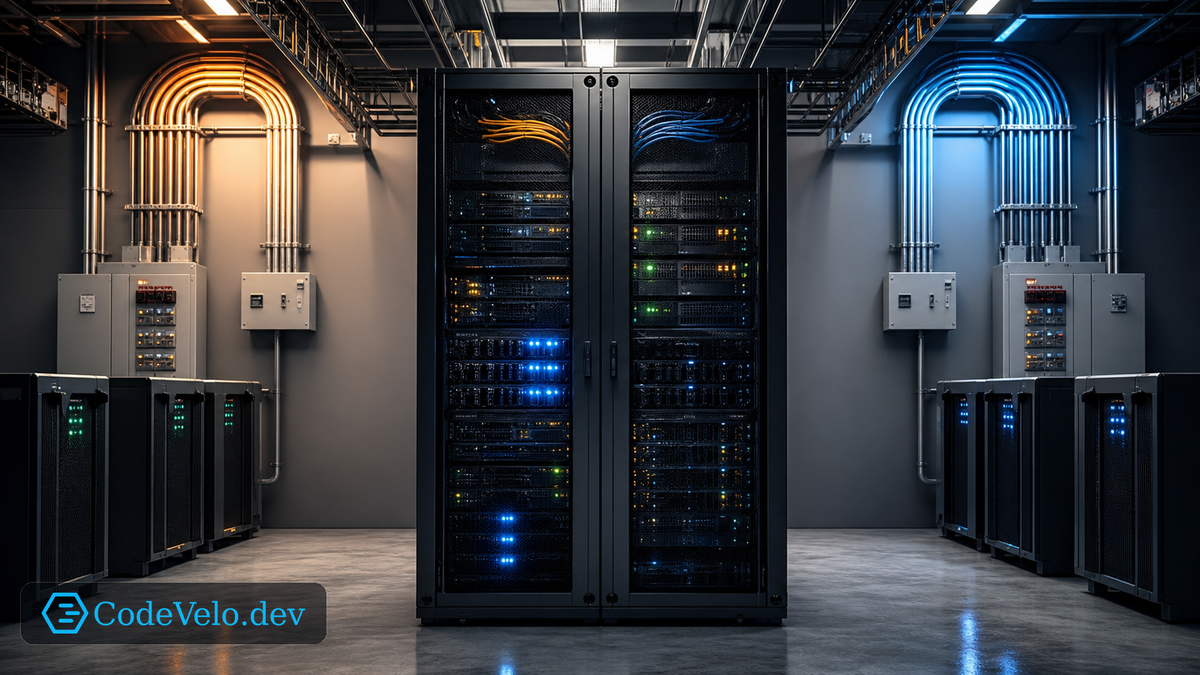
Most teams treat the UPS as the finish line for power resilience. Buy the battery, rack it cleanly, plug in the switch stack, and assume the facility is protected.
That is a start, not a strategy.
At CodeVelo.dev, we look at uptime from the wall to the browser. A UPS can absorb a short outage, condition dirty utility power, and keep equipment alive long enough for an orderly failover. But if every critical device depends on one utility path, one meter bank, one transformer, one transfer panel, or one electrical room, the whole stack is still exposed to a single physical failure.
That is where dual-grid entry becomes the next level of resilience.
1. The UPS Is a Bridge, Not a Destination
A UPS buys time. It does not create new power.
For high-draw PoE switches, storage appliances, edge compute nodes, network controllers, and security systems, that distinction matters. If a local outage lasts longer than the battery window, the UPS becomes a countdown timer. If the upstream feed is damaged, overloaded, or shut off for maintenance, the battery simply delays the inevitable.
The better question is not, "How big should the UPS be?"
The better question is, "What happens after the UPS starts discharging?"
In a mission-critical environment, the answer should include:
- A second upstream power path.
- A planned transfer method.
- A known runtime target.
- Load shedding rules for non-critical equipment.
- Monitoring that tells you which path is carrying the load.
The UPS is the bridge between those decisions. It should not be the only decision.
2. What Dual-Grid Entry Actually Means
Dual-grid entry is the practice of bringing two meaningfully separate utility or power feeds into a facility, then designing the internal electrical path so critical hardware can survive the loss of either feed.
The key word is meaningfully.
Two breakers in the same panel are not two diverse power paths. Two circuits from the same transformer are better than one, but still share a major dependency. Two feeds that enter the same room through the same conduit can still be taken out by the same physical event.
Useful diversity usually considers:
- Utility source diversity: Separate feeds, transformers, or service entrances where available.
- Physical path diversity: Different conduits, routes, rooms, or risers.
- Panel diversity: Critical loads split across separate panels or power distribution units.
- Transfer design: Manual transfer, automatic transfer, or dual-corded hardware depending on risk and budget.
- Maintenance isolation: The ability to service one side without taking everything offline.
The goal is not theoretical redundancy. The goal is making sure one local failure does not remove every path to power.
3. Mission-Critical Hardware Needs A/B Thinking
Software teams understand active-active, blue-green, and failover architecture. The physical layer needs the same discipline.
For infrastructure hardware, that often means designing around an A side and a B side:
- Dual power supplies land on separate PDUs.
- PDUs land on separate UPS units or transfer paths.
- Switches, firewalls, and storage nodes are distributed across both sides.
- Monitoring identifies whether a device is single-homed by accident.
- Labels and rack documentation make the topology obvious during an incident.
This matters because many outages are caused by maintenance, not disasters. Someone opens the wrong breaker. A UPS needs service. A panel replacement runs long. A contractor cuts the wrong conduit.
If your hardware has only one electrical story, every maintenance event becomes a production risk.
4. The Network And The Power Plan Must Match
Power redundancy is only useful if the network topology can survive the same failure.
If the A-side power path keeps the core switch alive but the only WAN handoff, firewall, or fiber converter is on the B side, the site may still be dark. If all access points are on one PoE switch, dual-grid power does not protect wireless coverage. If the backup circuit is installed beside the primary circuit, one physical incident can still cut both.
The physical-to-digital map should connect:
- Utility feeds.
- Panels and circuits.
- UPS and PDU paths.
- Switch stacks and PoE loads.
- WAN handoffs.
- Edge compute nodes.
- Monitoring and alerting.
When those layers are documented together, it becomes possible to run real failure drills instead of trusting diagrams that were never tested.
5. Designing For The Small Business Reality
Not every office can get two fully independent utility feeds. That does not mean resilience is impossible.
Smaller environments can still improve the power story by:
- Separating critical and non-critical loads.
- Using dual UPS units instead of one oversized battery.
- Splitting dual-corded devices across independent PDUs.
- Keeping network, storage, security, and internet handoff loads on documented circuits.
- Adding generator-ready transfer options where utility diversity is unavailable.
- Scheduling periodic pull-the-plug tests for controlled validation.
The practical target is not perfection. It is removing the cheapest and most obvious single points of failure first.
The CodeVelo Verdict
The UPS is necessary, but it is not enough. Real power resilience starts upstream, with diverse entry paths, clear load design, and hardware that can tolerate the loss of one side without turning an electrical event into a business outage.
In 2026, mission-critical infrastructure needs the same architectural thinking we already apply to software: no single path, no undocumented dependency, and no failover plan that has never been tested.
Is your infrastructure one breaker away from downtime? CodeVelo audits power, network, and edge hardware together so your physical layer can support the uptime your software promises. Start with a resilience review at CodeVelo.dev.