
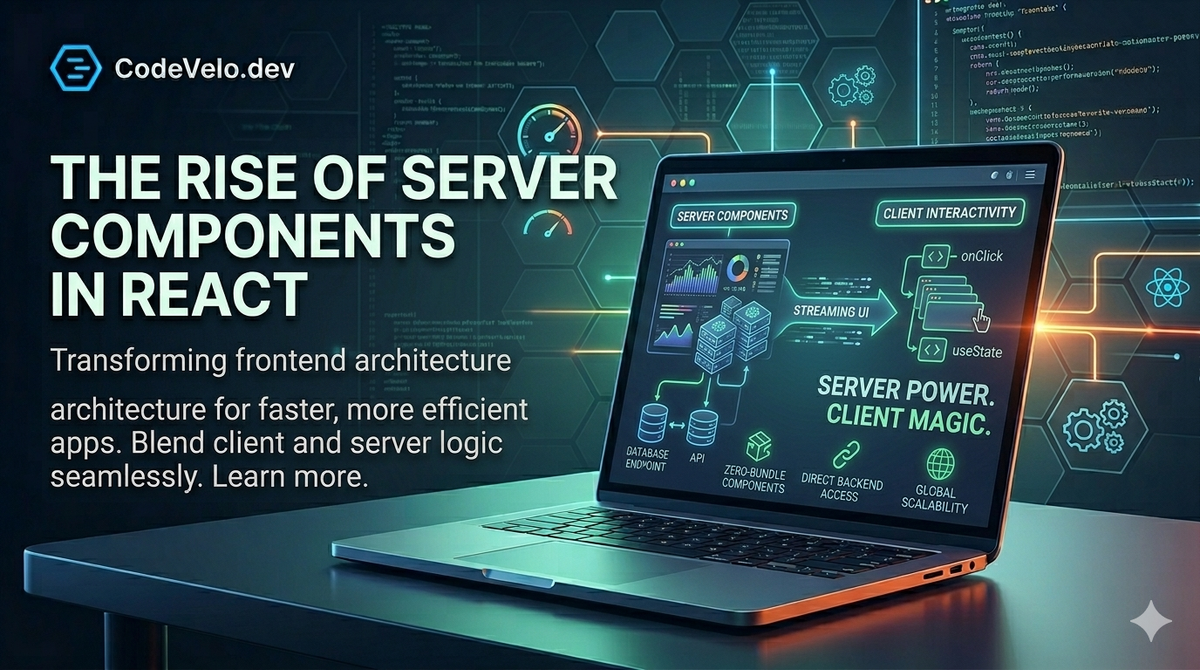
The React ecosystem has hit a major inflection point. For years, we relied on Client-Side Rendering (CSR) for interactivity and Server-Side Rendering (SSR) for initial loads. But as applications grew in complexity, so did the "JavaScript tax" paid by our users.
Enter React Server Components (RSC).
At CodeVelo.dev, we see RSC as the most significant shift in frontend architecture since the introduction of Hooks. It’s not just a new feature; it’s a new way to think about the relationship between the server and the client.
What Exactly are Server Components?
In a traditional React app, every component you write is bundled and sent to the browser. With Server Components, you can designate specific parts of your UI to stay on the server. They execute once, fetch their data directly from your database or file system, and stream a lightweight, non-interactive description of the UI to the client.
By shifting this work to the server, we eliminate the need to send large libraries (like Markdown parsers or date-formatting utilities) to the user’s device. If a component only needs to render static data, the browser never sees its source code—only the result.
Why RSC is a Game-Changer for Performance
The primary goal of RSC is to solve the "Waterfall" problem of data fetching.
1. Zero-Bundle-Size Components
Since Server Components don’t hydrate on the client, they contribute 0 bytes to your JavaScript bundle. This is a massive win for your Largest Contentful Paint (LCP), a metric we dive deep into in our post on Why Lighthouse Scores Matter.
2. Direct Backend Access
Because these components run on the server, you can query your database or internal APIs directly within the component body. This eliminates the need for redundant API endpoints and complex state management libraries, which we noted as a key trend in Frontend Tooling Essentials for 2025.
3. Progressive Streaming
RSC allows you to stream parts of your page as they become ready. You no longer have to wait for the entire data fetch to finish before showing the user something. This "fast-first" approach is at the heart of Building Lightning-Fast Websites.
The Perfect Pairing: RSC and the Edge
At CodeVelo, we don’t just run Server Components on a distant origin server. We leverage Edge Runtime to execute RSC logic as close to the user as possible.
Combining RSC with Edge Deployment means that even dynamic, data-driven components can be served with near-zero latency. It’s the ultimate recipe for global scalability: the efficiency of the server, the distribution of the edge, and the interactivity of React.
The Tradeoffs: When to Stay on the Client
It’s important to remember that Server Components aren't a replacement for Client Components. You still need the client for:
- Interactivity:
onClick,onChange, and anything requiringuseStateoruseEffect. - Browser APIs: Accessing local storage, geolocation, or the window object.
The magic happens in the "Interleaving"—the ability to nest Client Components inside Server Components seamlessly.
The CodeVelo Verdict
The rise of Server Components marks the end of the "Client-First" era. By moving heavy data-lifting and static rendering to the server, we can build richer experiences with significantly less overhead. For our team, this means faster development cycles and, more importantly, a significantly better experience for the end-user.
Ready to refactor your architecture for the RSC era? Explore how we build modern React applications at CodeVelo.dev.