
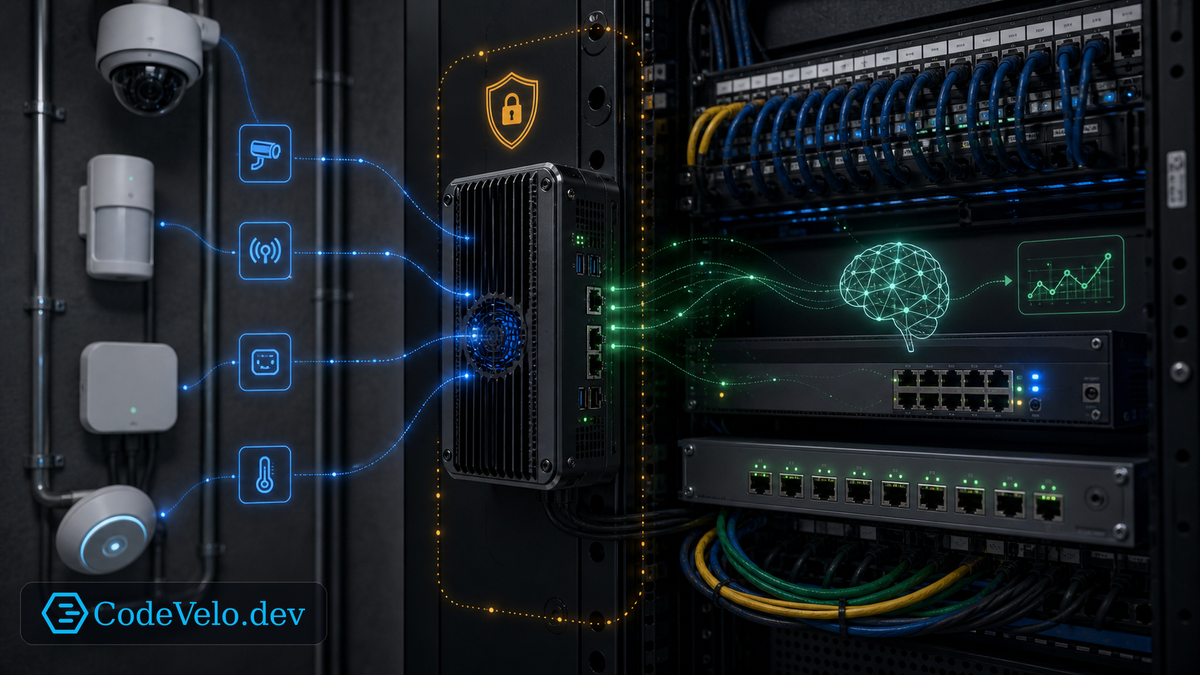
AI at the edge is not only a cloud architecture decision. It is a physical deployment decision.
When inference moves closer to cameras, sensors, access control, manufacturing equipment, or local applications, the gateway often lands in a wiring closet. That closet may not be ready for compute.
The device needs more than an Ethernet drop.
Treat The Gateway Like Infrastructure
An edge AI gateway may affect security, operations, and customer experience.
Plan for:
- Redundant power where required.
- UPS runtime and safe shutdown.
- Cooling and airflow.
- Physical security.
- Network segmentation.
- Remote management.
- Logging and lifecycle updates.
If the gateway becomes operationally important, it deserves infrastructure discipline.
Keep Data Local When It Helps
The strongest reason for edge AI is not novelty. It is locality.
Local inference can reduce latency, preserve bandwidth, and limit the amount of sensitive raw data sent upstream. A camera system may send events instead of continuous video. A sensor gateway may detect anomalies without waiting for cloud round trips.
That can improve both performance and privacy.
Segment The Trust Boundary
Edge AI devices often sit near operational technology, cameras, access systems, and business networks. That makes segmentation critical.
The gateway should have only the access it needs. Model updates, telemetry, management, and local data paths should be separated where practical. If the device is compromised, the blast radius should be small.
Do not let convenience turn the closet into a bridge between every network.
Monitor The Model And The Machine
Operations must watch both the hardware and the inference behavior.
Track CPU, GPU, temperature, storage, network, model version, input quality, event volume, and error rates. A healthy device running a bad model is still a production problem.
Edge AI succeeds when physical infrastructure and model operations are planned together.