
Latency optimization usually starts in software. Remove blocking JavaScript. Move compute closer to users. Cache aggressively. Reduce hops. Avoid expensive serialization.
Eventually, the conversation reaches the cable.
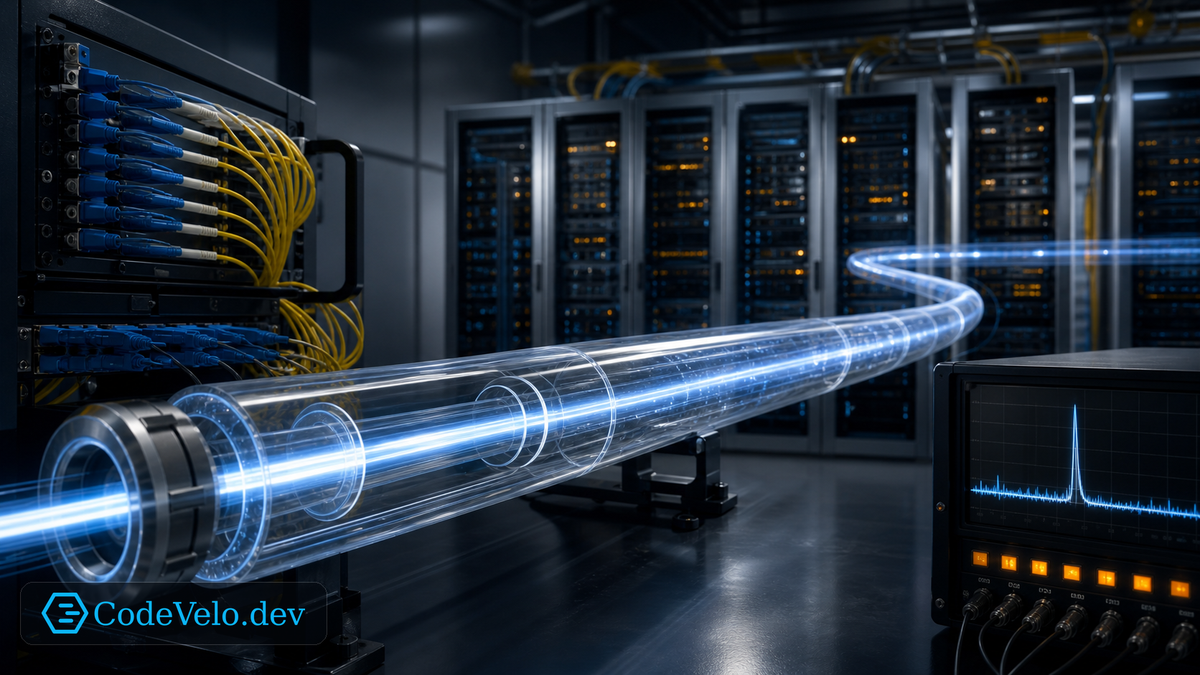
Hollow-core fiber matters because it attacks latency at the physical layer. Traditional fiber moves light through glass. Hollow-core designs guide light through an air-filled core, where propagation can be faster. The improvement is not magic, and it does not erase routing, switching, or application delay. But in environments where microseconds matter, physical media becomes part of the performance budget.
The Speed Of Light Is Not One Number
Teams often talk about "speed of light" networking as if the number were fixed. In practice, signals travel at different speeds depending on the medium and path. A direct path through better media can outperform a longer or more lossy route through cheaper infrastructure.
That is the practical lesson: latency is not only about bandwidth.
A 100Gbps link can still be slow for a trading workload, real-time control system, edge inference path, or high-volume replication flow if the route is physically inefficient.
Where Hollow-Core Makes Sense
Hollow-core fiber is not a universal cabling replacement. It is a specialty tool for high-value paths.
Good candidates include:
- Data center interconnects where replication lag matters.
- Campus links between compute-heavy buildings.
- Financial, research, or media workflows with tight timing requirements.
- Edge hubs that aggregate real-time sensor or control traffic.
- Any path where the cost of delay is measurable.
The strongest case appears when the link is already engineered carefully: clean routing, known endpoints, controlled installation, and monitoring that can prove the gain.
The Real Design Work
The cable is only one part of the result.
Engineers still need to validate bend radius, termination quality, connector handling, transceiver compatibility, route diversity, and maintenance process. A faster cable installed poorly becomes an expensive liability. A low-latency path that shares a vulnerable conduit with every other path still has a resilience problem.
The right question is not, "Can we buy faster fiber?"
The right question is, "Which physical paths are important enough to engineer as latency-critical infrastructure?"
Software Still Has To Respect The Gain
There is no point shaving microseconds from the physical layer if the application wastes milliseconds in hydration, queueing, retries, or unnecessary round trips.
Hollow-core fiber should be paired with edge-aware software design: fewer synchronous dependencies, direct data paths, efficient protocols, and observability that can separate network delay from application delay.
The physical reality of fast networking is simple: when latency matters, the stack includes the cable.