
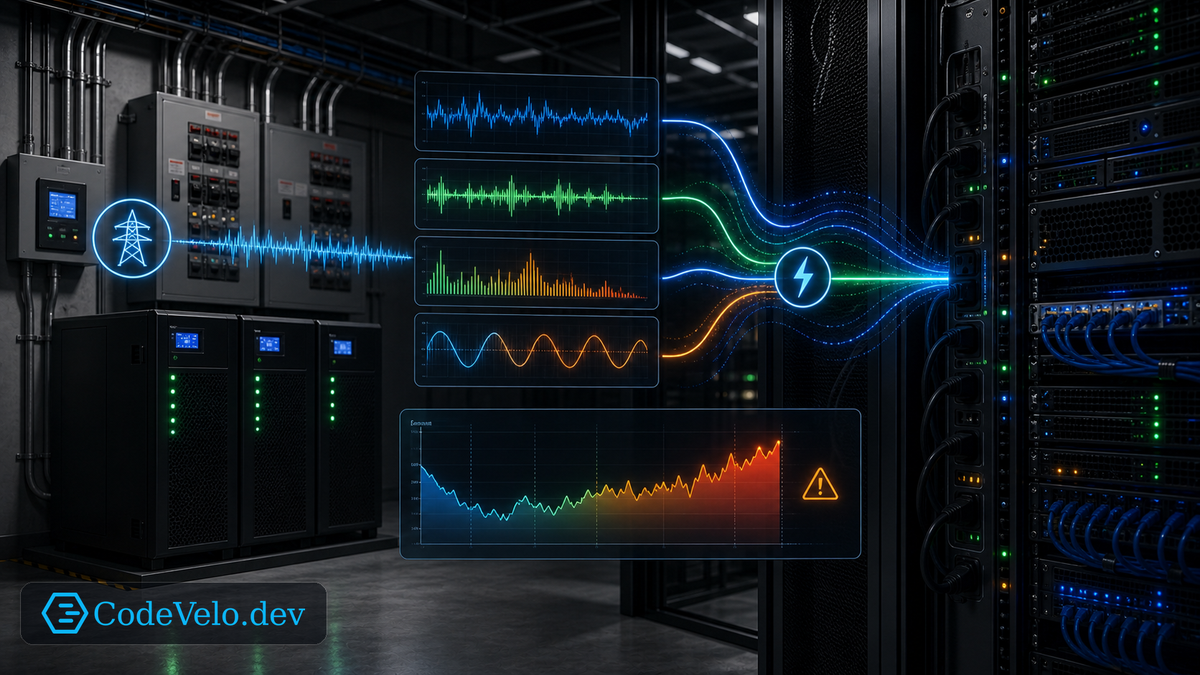
Most teams notice power when it disappears.
That is too late.
Power quality analytics looks at the conditions before failure: voltage sag, swell, frequency drift, harmonics, transfer events, UPS corrections, load imbalance, and repeated brownout patterns. These signals can reveal a stressed electrical path before hardware starts rebooting.
The UPS Knows More Than Runtime
UPS systems are often treated as batteries with alerts.
They can also provide operational data. Input voltage, output load, battery health, transfer count, temperature, and event history help teams understand whether the room is receiving stable power or constantly being corrected.
Frequent corrections are a signal, even if the devices stay online.
Look For Patterns
One voltage event may be noise. Repeated events at the same time of day, during HVAC startup, or under specific building load can indicate a real issue.
Correlate power quality with:
- Switch reloads.
- Storage warnings.
- Camera drops.
- UPS transfers.
- Generator tests.
- Weather and utility events.
The pattern is often more useful than the individual alert.
Measure At The Right Points
Power quality should be measured near critical loads, not only at the building entrance.
Panel, PDU, UPS, and device-level telemetry can show where instability appears. A clean utility feed does not guarantee clean power at a crowded rack.
Distance and distribution matter.
Turn Data Into Maintenance
Power quality analytics should drive action: electrician review, load balancing, UPS service, circuit separation, grounding checks, or utility escalation.
The goal is not to predict every outage. The goal is to stop treating electrical instability as invisible until it becomes downtime.