2025 Web Performance Recap
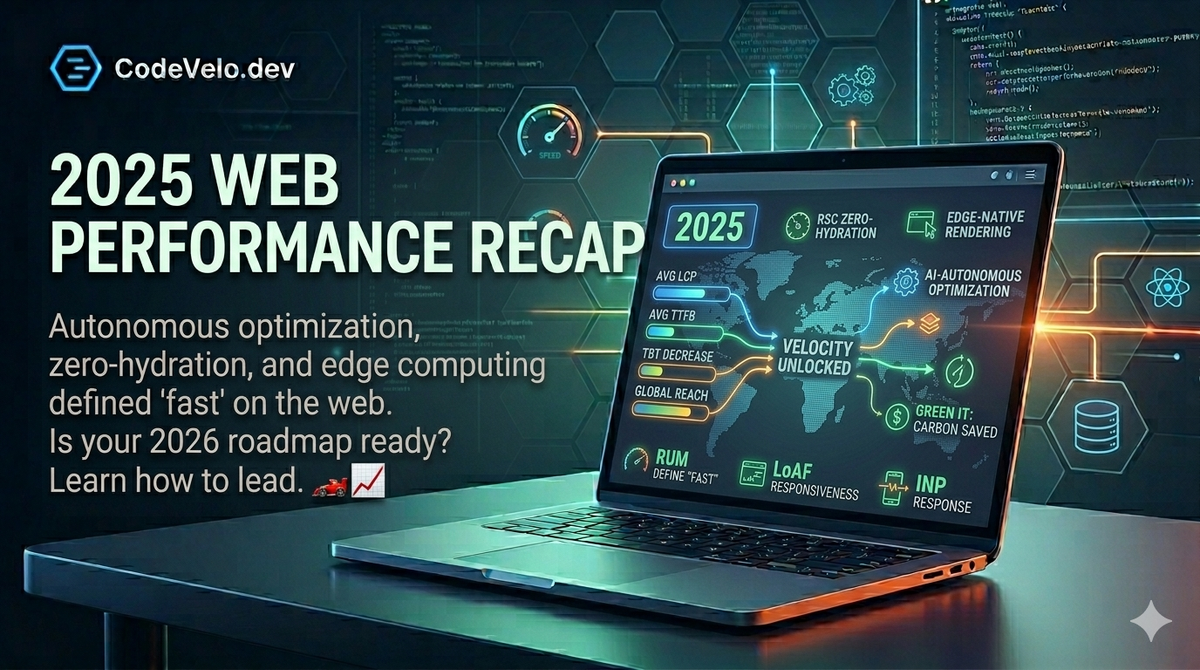
2025 was the year "fast" became a requirement, not a feature. From the death of the hydration gap to AI-driven autonomous debugging and edge-native rendering, we look back at the breakthroughs that redefined the modern web. Is your 2026 roadmap ready for the next level of velocity? 🏎️📈

As we move into the second quarter of 2026, it is clear that last year was a watershed moment for the open web. In 2025, we stopped talking about "performance as a goal" and started treating it as a hard requirement baked into the very infrastructure of the internet.
At CodeVelo.dev, we’ve tracked these shifts in real-time. From the death of the monolithic bundle to the rise of autonomous optimization, here is the technical breakdown of the breakthroughs that redefined the "Speed of Light" for web applications in 2025.
The Era of the "Zero-Hydration" Frontend
For years, the industry struggled with the "Hydration Gap"—that awkward moment where a page looks ready but remains frozen while JavaScript executes. 2025 finally solved this.
The mass adoption of React Server Components (RSC) changed the game. By shifting heavy logic to the server, we successfully moved the "JavaScript Tax" away from the user’s device. As we noted in our deep dive on The Rise of Server Components in React, this architectural shift allowed us to ship zero-bundle-size components, radically lowering Total Blocking Time (TBT) across the board.
Edge-Native Rendering: Physics is No Longer the Bottleneck
In 2025, the "Origin Server" officially became a fallback, not a primary destination. Performance leaders shifted toward Edge-Native Rendering.
By utilizing Edge Deployment, we began executing complex application logic millimeters away from the user. Combined with advanced Caching Strategies, this meant that the Time to First Byte (TTFB) became nearly identical for a user in London as it was for a user in Tokyo.
AI-Autonomous Optimization
2025 was the year AI moved from writing code to fixing performance. We saw the rise of tools that didn't just report a slow LCP score but actively patched the codebase to fix it.
Modern workflows now include:
- Automated Asset Grooming: AI models that automatically resize, reformat, and "lazy-load" images based on real-time viewport data.
- Predictive Prefetching: Using machine learning to predict which page a user will click next and pre-warming that Lightning-Fast Foundation at the edge.
- Autonomous Debugging: As highlighted in our Frontend Tooling Essentials for 2025, tools like Sentry and Datadog now offer "Self-Healing" suggestions that identify and resolve memory leaks before they reach production.
Metrics: The Evolution of "Fast"
Why Lighthouse Scores Matter remains a core truth, but 2025 saw the industry move toward Real User Monitoring (RUM) as the definitive source of truth. Synthetic benchmarks became the "lab," while RUM became the "real world."
We saw a shift in focus toward:
- INP (Interaction to Next Paint): Becoming the primary metric for responsiveness.
- LoAF (Long Animation Frames): Used to identify micro-stutters that traditional metrics missed.
- Carbon Consumption: Performance optimization is now a pillar of Green IT, as leaner code translates directly to lower energy usage at the data center level.
The CodeVelo Verdict
If 2025 taught us anything, it’s that performance is no longer a " hardening phase" at the end of a project. It must be a Practice in Every Sprint. The tools and frameworks of 2025 have given us the ability to build experiences that feel instantaneous, but they require a disciplined, "Performance-First" engineering culture to succeed.
Is your 2026 roadmap still catching up to 2025? Let’s get your stack up to speed. Explore our performance architecture services at CodeVelo.dev.