
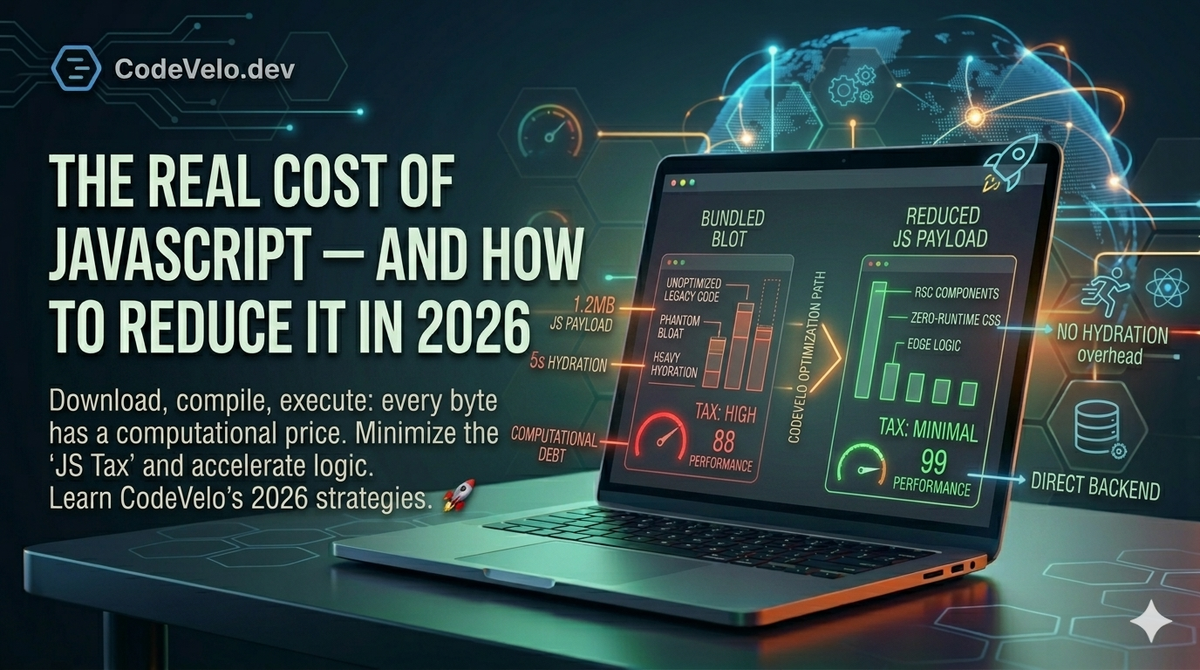
In the early days of the web, we worried about image sizes. Today, the primary bottleneck for modern applications is the "JavaScript Tax." While a 100KB image is just bytes over the wire, 100KB of JavaScript represents a massive computational debt: it must be downloaded, uncompressed, parsed, compiled, and eventually executed.
At CodeVelo.dev, we track the evolution of this cost. As we noted in our 2025 Web Performance Recap, the "Hydration Gap" has become the single biggest threat to a seamless user experience. Here is how to audit your JS footprint and reclaim your performance in 2026.
1. Understanding the Execution Cost
The "cost" of JavaScript is non-linear. On a high-end desktop, execution might take 50ms; on a mid-range mobile device, that same code can block the main thread for 500ms or more. This directly impacts your Interaction to Next Paint (INP) and Total Blocking Time (TBT).
To maintain Elite Lighthouse Scores, you must account for:
- Parsing/Compilation: The time the browser spends turning text into machine code.
- Hydration: The process of attaching event listeners to server-rendered HTML.
- Garbage Collection: The memory overhead of managing complex state objects.
2. Moving Logic to the Server with RSC
The most effective way to reduce JavaScript is to never ship it. In 2026, we lean heavily on React Server Components (RSC). By moving data-fetching and heavy library dependencies (like markdown parsers or date formatters) to the server, we ship zero client-side JS for those components.
This shift allows us to Scale Without Sacrificing Speed, as the client only receives the final HTML and a tiny fraction of the original logic.
3. Advanced Tree-Shaking and Dependency Audits
Many developers unknowingly ship "phantom bloat"—unused code bundled within third-party libraries. Using our Frontend Tooling Essentials, we implement:
- Module Sharding: Splitting large libraries into smaller, independently loadable chunks.
- Dependency Substitutions: Replacing heavy legacy libraries (like Moment.js or lodash) with modern, native Web APIs that have zero footprint.
- Automated Size Checks: Integrating hard limits into your Continuous Performance Pipeline to fail builds that exceed their JS budget.
[Image showing JS bundle breakdown before and after optimization]
4. Edge-Optimized Payload Delivery
In 2026, we don't just optimize what we ship; we optimize where we ship it from. By using Edge Deployment, we can dynamically serve different JS bundles based on the user's device capabilities. A legacy browser might receive a polyfilled bundle, while a modern "evergreen" browser receives a lean, ESNext-only version, saving significant bytes.
This works in tandem with global Caching Strategies to ensure that even the JS you must ship reaches the user with minimal latency.
The CodeVelo Verdict
JavaScript is the most expensive resource on the web. Reducing its cost requires a shift from "features first" to "performance first" engineering. By treating every kilobyte as a liability, you create an application that isn't just functional, but exceptionally fast. This is the hallmark of a Lightning-Fast Foundation.
Is your JavaScript tax too high? Let CodeVelo audit your bundles and streamline your execution. Visit us at CodeVelo.dev.