
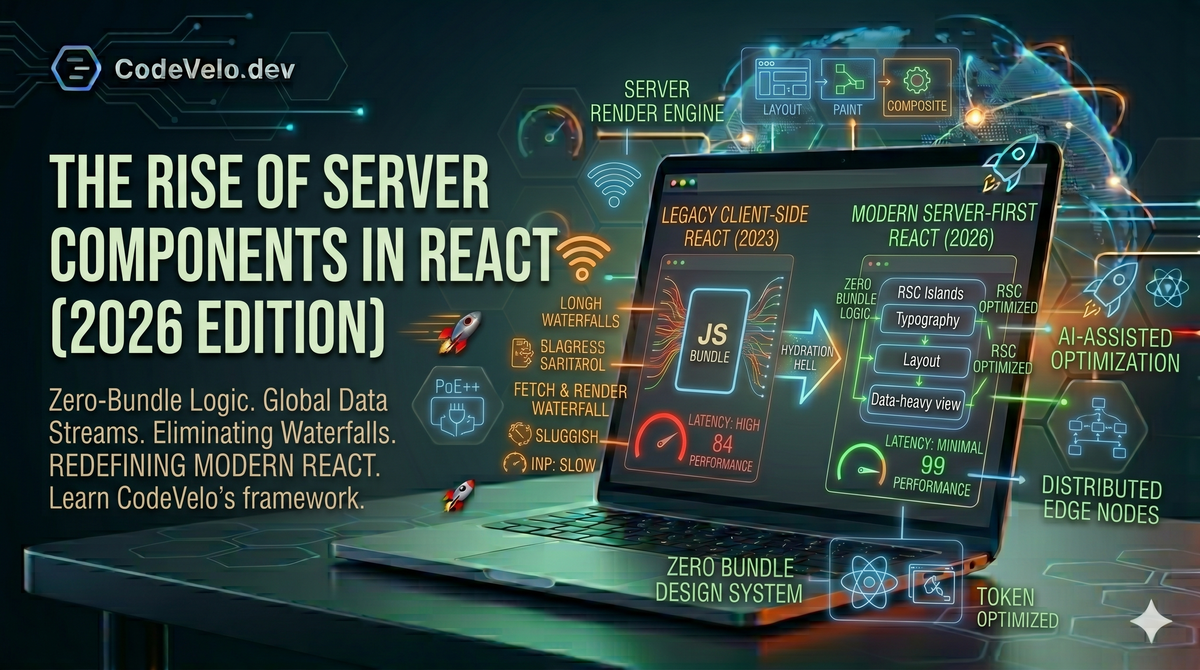
In the history of web development, few shifts have been as tectonic as the transition to React Server Components (RSC). What began as an experimental architecture has, in 2026, become the mandatory standard for any application aiming for a Lightning-Fast Foundation.
At CodeVelo.dev, we’ve spent the last few years helping teams migrate away from bloated, purely client-side applications. The 2026 landscape is clear: if you aren't leveraging RSC, you are essentially paying a JavaScript Tax that your competitors are not.
1. Zero-Bundle-Size Logic
The core promise of RSC has always been the ability to keep heavy dependencies on the server. In 2026, this has reached its logical conclusion. We now regularly build pages that feature complex data visualization, markdown parsing, and heavy formatting logic—all while shipping zero kilobytes of JavaScript for those features to the client.
By rendering these components into a streamable JSON format on the server, we drastically reduce the work the browser has to do. This directly translates to elite Lighthouse Scores and near-instant initial paints.
2. Patterns of 2026: The "Server-First" Design System
Our approach to Design Systems for Performance and Scalability has been completely rewritten for RSC. We no longer build "interactive-by-default" components. Instead, our 2026 pattern follows the "Island Architecture" within React:
- Server Components: Handle layout, typography, and data-fetching.
- Client Components: Reserved strictly for leaf-node interactivity (modals, toggles, form inputs).
This separation is managed automatically by our Frontend Tooling Essentials, which audits the "client-to-server ratio" of every route in our Continuous Performance Pipeline.
3. The Performance Breakthrough: Data-at-the-Edge
In 2026, the real magic of RSC happens when combined with Edge Deployment Strategies. By running Server Components on edge runtimes (like Cloudflare Workers or Vercel Edge), we bring the rendering logic closer to the user than ever before.
This eliminates the "waterfall" problem. Instead of the client fetching a bundle, then fetching data, then rendering, the edge node fetches data from an edge-local database and streams the rendered UI to the user in a single trip. This is how we Scale Without Sacrificing Speed.
4. Common Pitfalls and "Hydration Hell"
Despite its power, RSC is not a silver bullet. The most common mistake we see in Site Speed Framework audits is "Hydration Mismatch" caused by improper use of the 'use client' directive.
Passing non-serializable data (like functions) across the server-client boundary remains a frequent bottleneck. In 2026, we utilize AI-Assisted Web Performance tools to catch these boundary leaks during the dev cycle, preventing "Hydration Hell" before it hits production.
The CodeVelo Verdict
React Server Components represent the most significant performance optimization tool in a developer's arsenal since the introduction of the virtual DOM. By moving the "heavy lifting" to the server and the edge, we’ve finally decoupled application complexity from client-side performance.
Is your React stack still stuck in 2023? The migration to a server-first architecture is the single best investment you can make for your user experience. Start your transition today at CodeVelo.dev.