
Raw data is easy to come by; actionable insight is rare. In a world where every performance tool provides a mountain of metrics—from First Contentful Paint to Total Blocking Time—the real challenge isn't finding out your site is slow. The challenge is knowing exactly what to fix first to achieve the maximum ROI on your engineering hours.
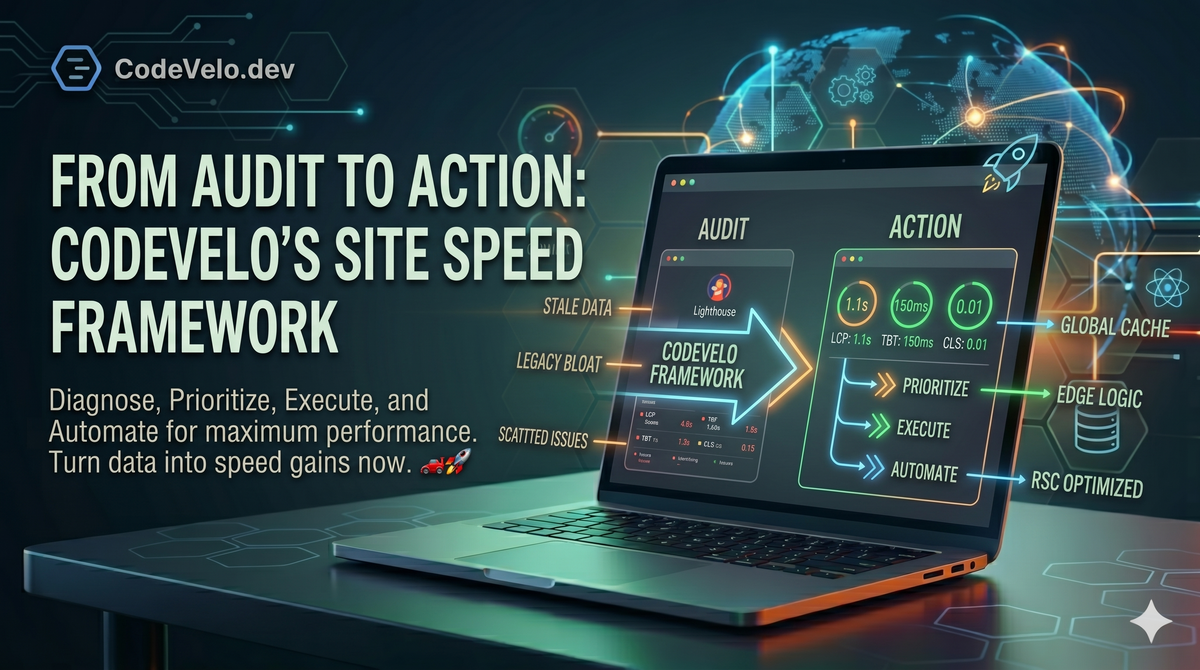
At CodeVelo.dev, we don’t believe in "shotgun optimization." We use a rigorous, repeatable Site Speed Framework to move from diagnostic audits to production-ready performance gains. Here is how we turn a failing Lighthouse report into a global speed advantage.
Phase 1: The Diagnostic Deep Dive
An audit is only as good as its environment. We begin by capturing a baseline using both synthetic "lab" data and Real User Monitoring (RUM).
We don't just look at the score; we look at the trace. By analyzing the critical rendering path, we identify whether the bottleneck is at the network layer, the server execution, or the main-thread JavaScript. As we’ve noted in our 2025 Web Performance Recap, the transition to INP (Interaction to Next Paint) as a core metric has changed how we diagnose "jank" in modern applications.
Phase 2: Prioritization via the "Performance Funnel"
Not all bottlenecks are created equal. We prioritize fixes based on their impact on the user’s perception of speed:
- Immediate Wins (The Low-Hanging Fruit): Implementing Caching Strategies and modern image formats (AVIF/WebP).
- Architectural Shifts: If the main thread is choked by JavaScript, we look to move logic to the server using React Server Components.
- Delivery Optimization: Moving static and dynamic logic to the network edge via Edge Deployment to eliminate RTT latency.
Phase 3: The Execution Sprint
Once the roadmap is clear, we execute. This is where Performance Optimization Every Sprint becomes critical. Instead of massive, risky refactors, we apply surgical changes:
- Tree-shaking and Code Splitting: Using the latest Frontend Tooling to ensure we only ship the bytes that matter.
- Payload Reduction: Eliminating legacy polyfills and non-critical CSS.
- Database Refactoring: If the TTFB is high, we audit the backend queries and implement sharding to Scale Without Sacrificing Speed.
Phase 4: Locking in the Gains
Performance is a depreciating asset. Without guardrails, your site will slow down again. The final stage of our framework is the implementation of a Continuous Performance Pipeline. We automate the audit process within your CI/CD, setting performance budgets that prevent a single bad PR from undoing weeks of work.
The CodeVelo Verdict
Optimization isn't a project; it's a process. By following a structured framework—from diagnostic deep dives to automated guardrails—CodeVelo ensures that your performance gains aren't just temporary spikes on a chart, but a permanent foundation for your business's growth.
Stop guessing and start accelerating. Let CodeVelo apply our Site Speed Framework to your stack today at CodeVelo.dev.