
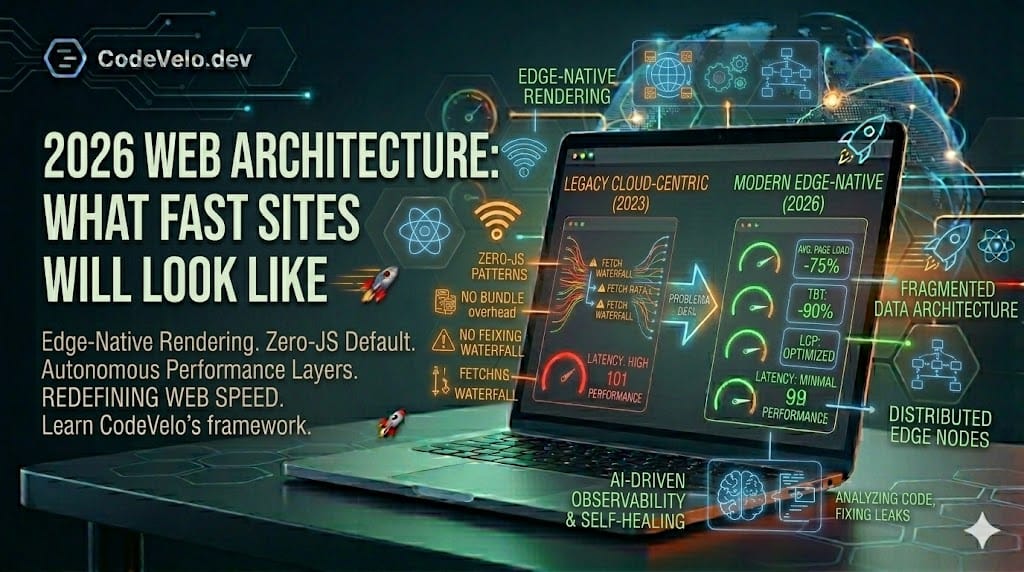
By the end of 2026, the benchmark for a "fast" website will have shifted from seconds to milliseconds. We are moving away from the era of massive client-side frameworks and centralized cloud computing into an age of distributed intelligence and extreme modularity.
At CodeVelo.dev, we track these architectural shifts to ensure our clients maintain a Lightning-Fast Foundation. Here is our blueprint for the high-performance web architecture that will define the end of 2026.
1. Edge-Native Rendering (ENR)
In 2026, the "Origin Server" is a fallback, not a primary destination. The fastest sites will utilize Edge-Native Rendering. Unlike traditional SSR (Server-Side Rendering) that happens in a data center, ENR occurs on the edge node physically closest to the user.
By combining Edge Deployment Strategies with React Server Components, sites will stream fully rendered HTML to the user in under 50ms. This eliminates the "spinning loader" culture of the mid-2020s and ensures that even the most complex applications feel like local software.
2. Zero-JS Patterns as the Default
The Real Cost of JavaScript has finally been quantified by the market. In 2026, the fastest sites will follow a "Zero-JS by default" pattern. Interactivity will be handled by:
- CSS Next-Gen: Leveraging advanced pseudo-classes and container queries to handle UI states that previously required JS.
- Wasm Modules: Moving heavy computation (like image processing or data encryption) to WebAssembly for near-native speeds.
- Islands of Interactivity: Using frameworks that only "hydrate" the specific Micro-Interactions a user is actually touching.
3. The Autonomous Performance Layer
Manual performance tuning is becoming a legacy skill. 2026 web architecture features an Autonomous Performance Layer powered by AI-Assisted Web Performance engines.
These sites will self-optimize in real-time by:
- Predictive Asset Loading: Using ML to guess the user's next move and pre-loading those specific edge fragments.
- Dynamic Code Sharding: Automatically breaking up bundles based on the user's actual device constraints and network conditions detected via Professional Network Infrastructure.
4. Fragmented Data Architecture
The monolithic database is being replaced by Fragmented Data Architecture. To Scale Without Sacrificing Speed, data will be stored in global, sync-on-demand cells. This ensures that a user in Tokyo isn't waiting for a database query to resolve in London. This localized data approach is the backbone of our Site Speed Framework.
The CodeVelo Verdict
The 2026 web is invisible. It is so fast, so responsive, and so tailored to the user's environment that the technology fades into the background. Achieving this requires a holistic view of performance—from the Clean Rack Builds in your office to the edge runtimes in the cloud.
Is your architecture ready for the 2026 standard? Don't get left in the legacy cloud. Partner with CodeVelo.dev to build the future of the web today.