
In the high-stakes world of enterprise software and global commerce, we often treat "the network" as an invisible utility. However, for a team pushing code to a Continuous Performance Pipeline or running real-time AI-Assisted Web Performance audits, a mediocre WiFi connection is a massive bottleneck.
At CodeVelo.dev, we’ve seen that commercial WiFi performance is defined by architecture, not "bars." If your physical layer is flawed, your digital velocity will suffer. Here is how to engineer a professional-grade wireless environment that supports a Lightning-Fast Foundation.
1. The Science of AP Placement
A common mistake in Network Installation is placing Access Points (APs) based on convenience rather than RF (Radio Frequency) physics.
- Avoid the "Hallway Trap": Placing APs in hallways leads to signal bleed into rooms at suboptimal angles, increasing multipath distortion. APs should be placed inside high-density areas where users actually work.
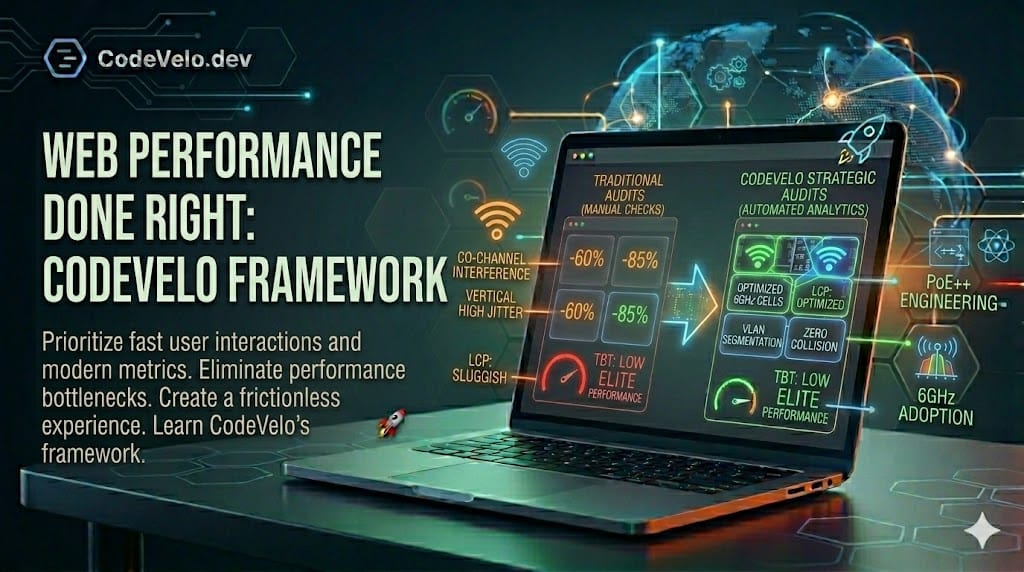
- Three-Dimensional Planning: In multi-floor offices, APs should be staggered across floors to prevent vertical co-channel interference.
- Capacity vs. Coverage: In 2026, we don't design for coverage (signal reach); we design for capacity (the number of concurrent high-bandwidth streams).
2. Power over Ethernet (PoE) Engineering
Your APs are only as reliable as the switches powering them. Professional installation requires a strict PoE budget analysis.
Modern Wi-Fi 6E and Wi-Fi 7 APs require higher power draws (often PoE+ or PoE++). If your Rack Organization doesn't account for total wattage, you’ll experience intermittent AP reboots. These "micro-outages" trigger costly re-connections that can inflate your Real Cost of JavaScript metrics as apps struggle to re-sync state.
3. VLAN Segmentation for SaaS Reliability
A "flat" network where guest phones, IoT thermostats, and developer workstations share the same broadcast domain is a recipe for high latency.
We implement strict VLAN Segmentation to protect production bandwidth:
- Production VLAN: Prioritized traffic for engineering and SaaS applications.
- IoT/Hardware VLAN: Isolated traffic for printers and building sensors.
- Guest VLAN: Rate-limited and completely isolated from internal resources.
This segmentation ensures that a large download on the guest network doesn't cause a Lighthouse Score drop during a critical deployment.
4. RF Management and 6GHz Adoption
In 2026, the 2.4GHz band is for lightbulbs, and the 5GHz band is for legacy devices. For high-performance teams, 6GHz (Wi-Fi 6E/7) is the standard.
By utilizing the wider, uncrowded channels of the 6GHz spectrum, we eliminate contention overhead. This reduces jitter, which is critical for Micro-Interactions and real-time collaboration tools. Our Site Speed Framework extends to the airwaves: we audit the RF environment to ensure no neighboring networks are "stepping" on your production channels.
The CodeVelo Verdict
Commercial WiFi isn't just about connectivity; it's about productivity insurance. When you Scale Without Sacrificing Speed, your physical infrastructure must be as agile as your code.
Is your office network a hidden bottleneck? Performance starts at the cable. Let CodeVelo engineer a wireless strategy that keeps your team at peak velocity. Explore our infrastructure services at CodeVelo.dev.