Edge Deployment Strategies for 2026
The origin server is dead. In 2026, speed is won at the edge. Learn how CodeVelo uses global runtimes, edge-native databases, and multi-cloud orchestration to deliver lightning-fast, personalized experiences to every user, regardless of location. 🌍⚡🚀

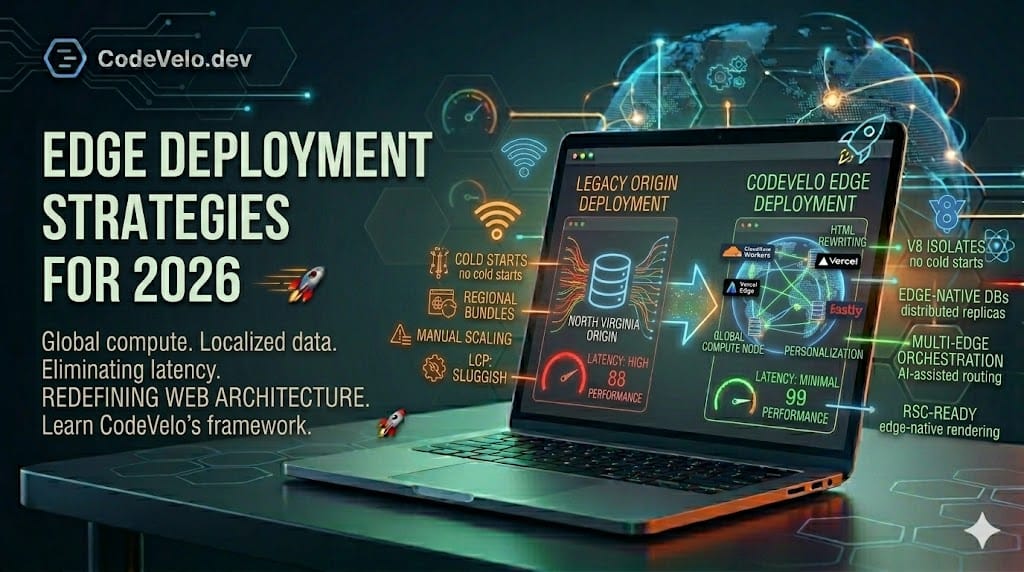
The era of the "Origin Server" is effectively over for high-performance applications. In 2026, the distance between your user and your code is measured in microseconds, not miles. If your application logic is still sitting in a single data center in Northern Virginia, you are providing a legacy experience to a global audience.
At CodeVelo.dev, we’ve moved past simple static caching. We now architect for Global Runtime Execution, where every user request is handled by a compute node physically closest to them. Here is how we leverage Edge Deployment to build the Lightning-Fast Foundations of the future.
1. Beyond the CDN: The Rise of Edge Runtimes
In 2026, the distinction between a CDN and a server has blurred. Platforms like Cloudflare Workers, Vercel Edge, and Fastly’s Compute@Edge allow us to run complex logic—like authentication, A/B testing, and dynamic headers—at the network frontier.
Unlike traditional Node.js environments, these runtimes use V8 Isolates. This means zero "cold start" times, allowing your site to respond instantly. We integrate these runtimes into our Frontend Tooling Essentials to ensure that the developer experience (DX) matches the user experience (UX).
2. Global Database Persistence (Edge-Native DBs)
The biggest challenge for edge computing used to be the "Data Gravity" problem—the compute was at the edge, but the database was still in a central region. In 2026, we solve this with Edge-Native Databases like Turso (libSQL), Cloudflare D1, and Neon.
By utilizing read-replicas that follow the user, we reduce the Real Cost of JavaScript spent waiting for data fetching. When combined with React Server Components, we can render data-heavy pages at the edge and ship pure HTML to the user.
3. Dynamic Personalization at Scale
Traditional personalization often leads to "Layout Shift" (CLS) as the client-side JS kicks in to swap content. With an edge-first strategy, we perform HTML Rewriting at the edge node.
Before the first byte even reaches the browser, our edge middleware:
- Detects the user's location and language.
- Checks authentication status via global KV stores.
- Injects personalized content into the stream.
This results in a personalized experience with a Lighthouse Score of 100, as the browser receives a fully formed, personalized document immediately.
4. Intelligent Traffic Orchestration
Relying on a single edge provider is a risk. Our 2026 strategy involves Multi-Edge Orchestration. Using AI-Assisted Web Performance logic, we can dynamically route traffic between providers (e.g., from Netlify to Cloudflare) based on real-time regional performance or outages.
This level of resilience is critical to Scale Without Sacrificing Speed. It mirrors the redundancy we demand in Commercial Network Installations—your digital infrastructure must be as robust as your physical one.
The CodeVelo Verdict
Edge deployment is no longer an "optimization"—it is the standard for modern web architecture. By pushing compute, data, and logic to the network's edge, you eliminate the latency that kills conversions. This is the ultimate execution of our Site Speed Framework.
Is your application still stuck in the center of the world? Bring your code to your users. Explore our global deployment audits at CodeVelo.dev.