
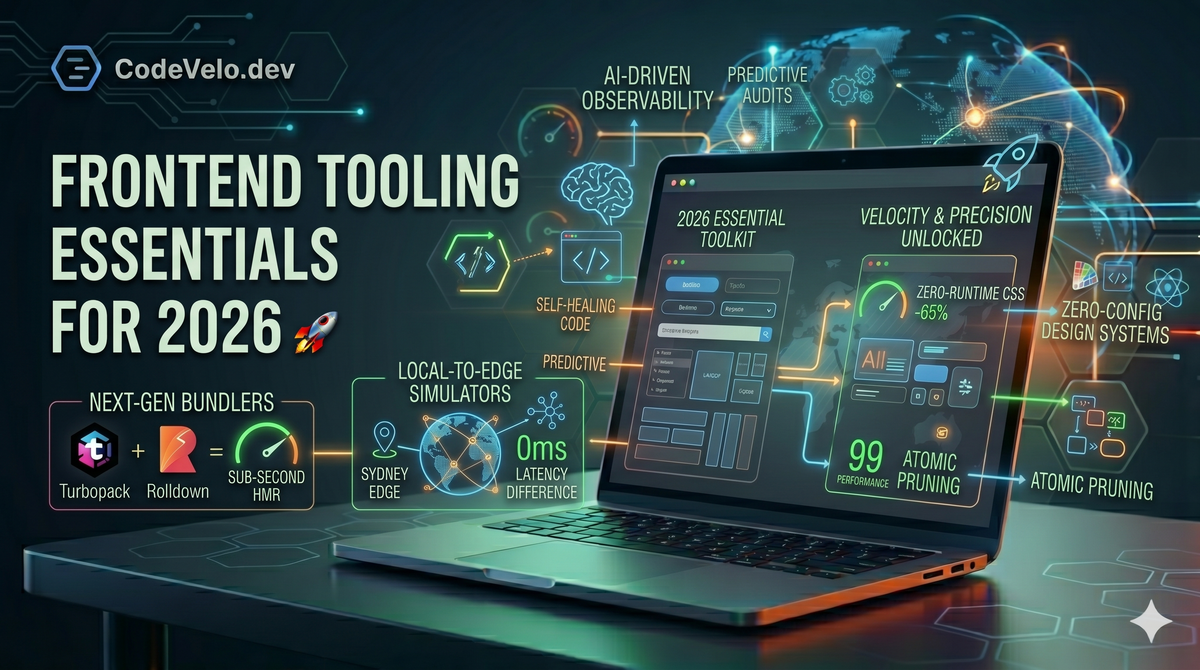
The "localhost" of 2026 looks radically different than it did even two years ago. We have officially moved past the era of waiting for builds to finish and manual performance auditing. Today, the modern frontend stack is defined by autonomous optimization and instantaneous feedback loops.
At CodeVelo.dev, our philosophy is simple: your tools should work as hard as your code. If you aren't leveraging the latest in AI-assisted debugging and edge-native local development, you're building with one hand tied behind your back.
Here is the essential toolkit for a Lightning-Fast Foundation in 2026.
1. Next-Gen Bundlers: The Rise of Rolldown and Turbopack
In 2026, we no longer tolerate "cold start" times. The mass adoption of Rolldown (the Rust-based successor to Rollup) and the maturity of Turbopack have made sub-second HMR (Hot Module Replacement) the industry standard, even for enterprise-scale monorepos.
These tools are essential for Kickstarting 2026 with Blazing-Fast Builds, as they natively handle tree-shaking for React Server Components without the configuration overhead of the past.
2. AI-Driven Debugging & Observability
We have moved beyond simple console logs. Modern tooling now includes LLM-Integrated Debuggers that don't just point to an error; they analyze the stack trace and suggest a performance-optimized fix in real-time.
- Self-Healing Observability: Tools like Sentry now utilize AI to automatically detect memory leaks and The Real Cost of JavaScript in specific user segments.
- Predictive Performance Audits: Before you even push to a Continuous Performance Pipeline, these tools simulate real-world throttle conditions to predict your Lighthouse Scores.
3. Local-to-Edge Simulators
In 2026, "it works on my machine" must also mean "it works at the Sydney edge node." Essential tooling now includes native local simulators for Edge Deployment.
These simulators allow developers to test Caching Strategies and middleware logic locally with zero latency difference from production. This is critical for teams trying to Scale Without Sacrificing Speed.
4. Zero-Config Design System Kits
Design systems have evolved from static UI libraries into performance-centric engines. Tools that support Zero-Runtime CSS and Design Token Transformers are now mandatory.
As we noted in Design Systems for Performance and Scalability, the goal is to ship tokens, not bloat. Modern kits automatically prune unused styles at the component level, ensuring your Site Speed Framework remains intact as you grow.
The CodeVelo Verdict
The frontend landscape in 2026 is about velocity and precision. By automating the "boring" parts of development—bundling, auditing, and basic debugging—we free up engineering talent to focus on what truly matters: the user experience.
Is your dev environment stuck in the past? Let CodeVelo modernize your stack. Explore our tooling audits at CodeVelo.dev.