Self-Healing Frontends: Error Boundary Patterns
A resilient frontend does not pretend failures will disappear. It contains them, keeps useful UI alive, and gives the edge enough context to recover cleanly.

Journal
Practical engineering from the rack to the runtime.
A resilient frontend does not pretend failures will disappear. It contains them, keeps useful UI alive, and gives the edge enough context to recover cleanly.

A UPS protects you from seconds of power instability. Dual-grid entry protects you from losing the building. Here is how mission-critical teams design diverse power paths before the battery ever has to work.

The CodeVelo Audit connects infrastructure, software delivery, and business operations. It helps teams find the bottlenecks that sit between network hardware and application code.

INP measures whether a page responds when users interact with it. Improving it means reducing main-thread work, long tasks, and avoidable JavaScript delays.

Small server closets fail quietly when heat has nowhere to go. Airflow, blanking, equipment placement, and active exhaust can extend reliability without a full HVAC rebuild.

Islands architecture keeps static HTML as the baseline and hydrates only the interactive parts. That split can reduce JavaScript cost without giving up rich UI.

UPS sizing for PoE switches requires more than counting outlets. Power draw, surge behavior, runtime targets, and waveform quality all affect reliability.
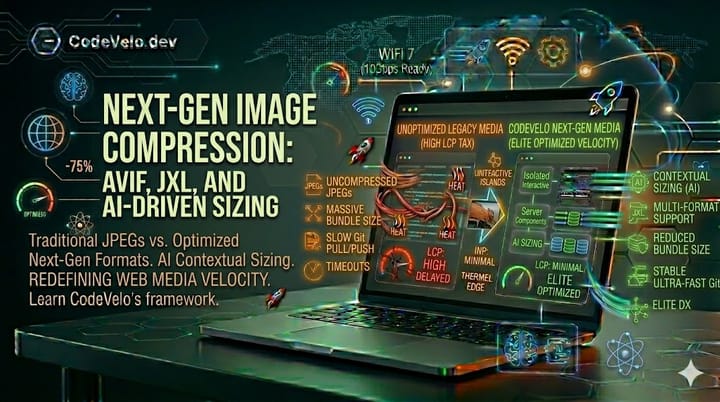
Image strategy affects LCP, bandwidth, and visual quality. AVIF, JPEG XL, responsive sizing, and quality automation all help reduce unnecessary page weight.

A flat network lets unrelated devices share too much trust. VLAN segmentation separates guests, cameras, workstations, servers, and build systems by risk.