
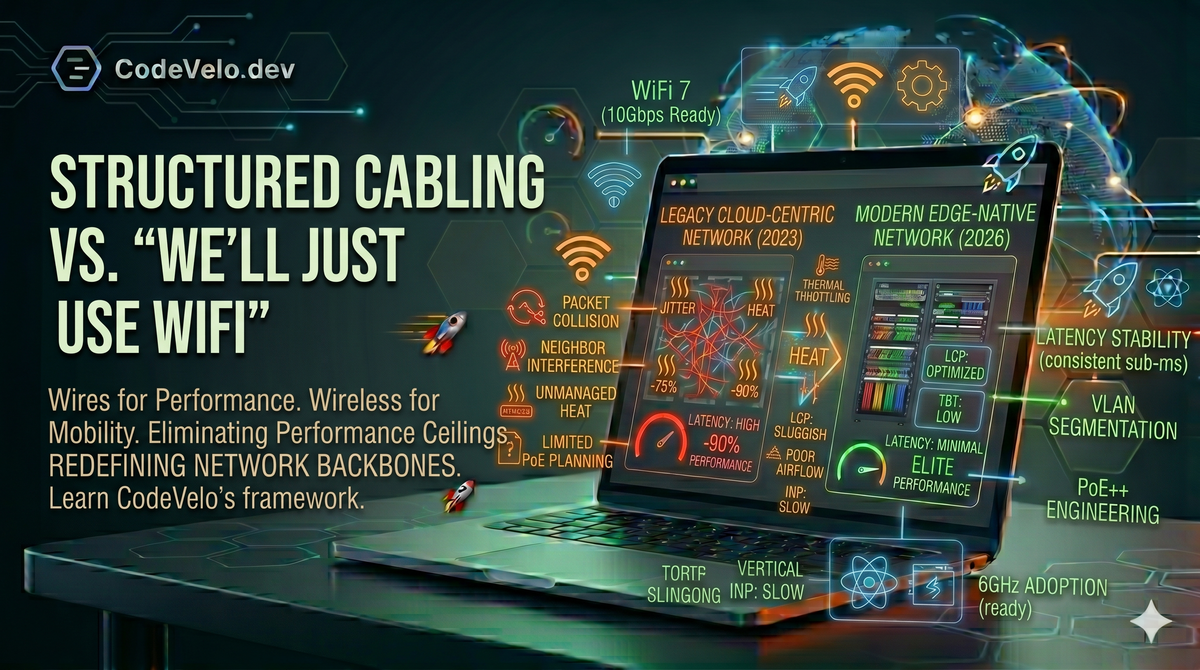
In the pursuit of a modern, "wireless" office, many small to mid-sized businesses make a critical architectural error: they assume that a strong WiFi signal is a substitute for a wired backbone. At CodeVelo.dev, we’ve audited dozens of environments where the primary bottleneck to SaaS Reliability wasn't the ISP—it was the airwaves.
While we are experts in Commercial WiFi Done Right, we know that the fastest wireless experience is only possible when it’s built on a foundation of professional structured cabling.
1. The Latency Ceiling: Jitter vs. Stability
WiFi is a shared medium. Every device on a frequency band is essentially "shouting" to be heard. This leads to packet collisions and re-transmissions, which manifest as jitter—the variance in time between data packets arriving.
For developers running a Continuous Performance Pipeline or teams engaging in high-fidelity video conferencing, jitter is the enemy. Structured cabling (Cat6A or Cat7) provides a dedicated, shielded pathway for data.
- WiFi: Variable latency based on physical obstructions and neighbor interference.
- Cabled: Consistent, sub-millisecond latency that ensures your Micro-Interactions feel as fast in the office as they do on the server.
2. Power over Ethernet (PoE) and Infrastructure Density
"Just using WiFi" ignores the hardware required to make WiFi work. High-performance Access Points (APs) in 2026 require significant power. A professional Network Installation uses structured cabling to deliver both data and power via PoE++ to your APs, cameras, and VoIP phones.
Without a wired plan, you end up with "cable sprawl"—ugly power adapters plugged into random wall outlets, creating the exact Clean Rack Build nightmare we warn against.
3. Security and VLAN Segmentation
WiFi is inherently more vulnerable to spoofing and unauthorized access. Structured cabling allows for physical security—you know exactly which device is plugged into which port.
Furthermore, a wired backbone makes VLAN Segmentation more robust. We can hardwire critical production machines to a high-priority VLAN, ensuring that guest WiFi traffic or "smart" office devices don't compete for the bandwidth needed for AI-Assisted Web Performance audits or large Git pushes.
4. Future-Proofing for 2026 and Beyond
As we move toward Edge-Native Web Architecture, the volume of data moving within your local network is increasing.
- WiFi 7 is incredible, but it requires a 10Gbps wired uplink to the switch to actually deliver its promised speeds.
- Structured Cabling isn't just for desktops; it's the "highway system" that feeds your wireless "local roads."
If you don't invest in the copper (or fiber) today, you are capping your team's potential before they even open their laptops.
The CodeVelo Verdict
The debate shouldn't be "WiFi vs. Cabling"—it should be "WiFi plus Cabling." A wireless-only office is a house built on sand. Structured cabling provides the stability, security, and power delivery that a Lightning-Fast Foundationrequires.
Is your network built to scale? Don't let your physical layer be your performance ceiling. Let CodeVelo design a hybrid infrastructure that works. Explore our services at CodeVelo.dev.