AI-Assisted Web Performance
Stop reacting to slow speeds and start predicting them. In 2026, AI-assisted performance is redefining web architecture through predictive caching, self-healing code audits, and autonomous edge orchestration. Learn how CodeVelo leverages ML to keep your site fast 24/7. 🤖⚡🏎️

For years, web performance was a game of manual adjustments—tweaking image compression ratios, hand-writing media queries, and manually auditing bundles. But in 2026, the complexity of modern web apps has outpaced human-only optimization. We have entered the era of Autonomous Performance.
At CodeVelo.dev, we’ve integrated artificial intelligence not as a gimmick, but as a core architectural layer. By moving from reactive fixes to predictive optimizations, we ensure your site stays at peak velocity without constant developer intervention.
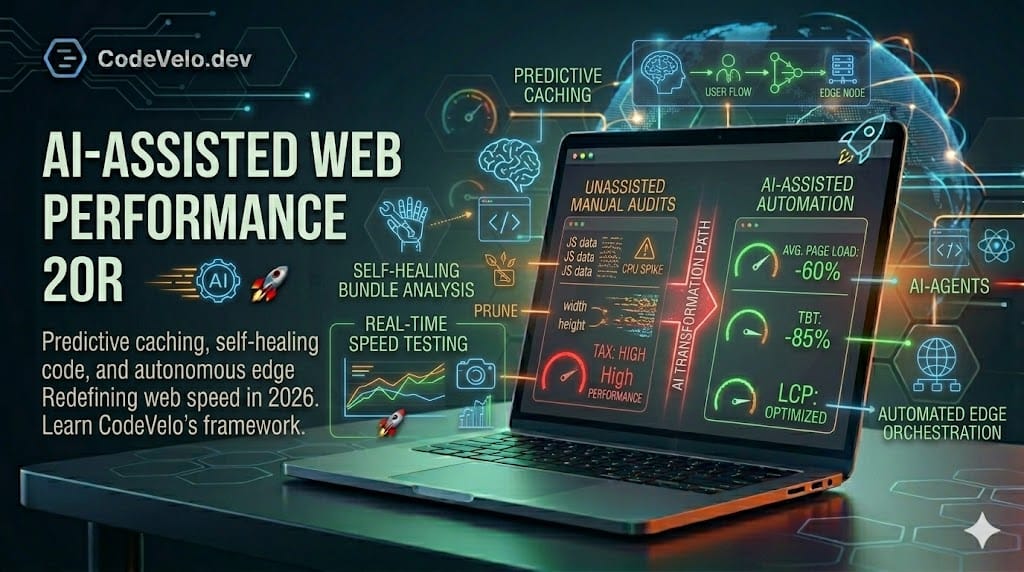
1. Predictive Caching and Pre-fetching
Traditional Caching Strategies rely on static rules: "Cache this for 24 hours" or "Pre-fetch this specific link." AI-assisted performance changes the logic to probabilistic pre-fetching.
By analyzing real-time user flow data, machine learning models can predict with 90%+ accuracy which asset a user will need next.
- Dynamic Pre-warming: If the model predicts a user is moving toward the checkout, the Edge Deployment nodes can pre-warm the necessary API fragments before the click even happens.
- Smart Hydration: AI determines which components are most likely to be interacted with first, prioritizing the Real Cost of JavaScript for those specific elements.
2. AI-Powered Bundle Analysis
In our Frontend Tooling Essentials for 2026, we highlighted the move toward "self-healing" builds. Modern AI agents now sit inside your Continuous Performance Pipeline to perform deep code audits.
Instead of just telling you a bundle is too large, the AI:
- Identifies "dead" execution paths that tree-shaking missed.
- Suggests moving specific logic to React Server Components to zero out the client-side footprint.
- Automatically generates optimized versions of assets based on the user's specific device profile.
3. Real-Time Visual Regression & Speed Testing
Performance isn't just about the numbers; it's about the Perceived Performance. AI models now perform visual audits during the rendering process. They can detect "Layout Shift" (CLS) issues before they reach production, identifying the exact Micro-Interaction or un-sized image causing the jank.
By comparing your current deployment against your Site Speed Framework goals, the AI provides a natural-language summary of where your Lighthouse Scores are at risk and how to fix them.
4. Automated Edge Orchestration
At the infrastructure level, AI is now managing traffic routing. If a specific region is experiencing high latency, the AI-driven Network Installation logic can dynamically reroute traffic to healthier edge nodes or adjust the TTL (Time to Live) of cached assets to compensate. This ensures you Scale Without Sacrificing Speed, regardless of global network conditions.
The CodeVelo Verdict
AI hasn't replaced the performance engineer; it has given them a superpower. By automating the repetitive auditing and predictive tasks, we allow our teams to focus on high-level architecture and user experience. In 2026, if your performance strategy isn't AI-assisted, you aren't just behind the curve—you're losing the race.
Ready to bring autonomous speed to your stack? See how we build for the future at CodeVelo.dev.